The allergy aisle now has three genuinely different kinds of nasal spray sitting a few inches apart — a steroid, an antihistamine, and a decongestant — and they are not interchangeable. One is built for daily, ongoing control. One works in minutes but isn't meant for months of continuous use. One should never be used for more than a few days at a time, full stop. This guide ranks the actual nasal sprays worth buying for allergies, is specific about how each one works and how fast, and explains — honestly — why the fastest-acting option on the shelf is also the one you should generally leave there.
This article is for general education and isn't a substitute for advice from your own physician, pharmacist, or allergist.
Quick Answer
Flonase (fluticasone) is the best overall nasal spray for allergies — intranasal steroids outperform oral antihistamines for congestion in meta-analyses — but they take 3-4 days of daily use to reach full effect. Astepro (azelastine) works within about 30 minutes if you need faster relief, and saline rinses are the safe daily add-on. Never use a decongestant spray like Afrin beyond 3 days.
The Three Kinds of Nasal Spray, and Why They're Not Interchangeable
Intranasal corticosteroids (INCS) — fluticasone (Flonase), triamcinolone (Nasacort), and similar drugs — reduce the underlying inflammation that causes congestion, sneezing, and runny nose. They're the closest thing allergic rhinitis has to a first-line, standard-of-care treatment: a systematic review of randomized controlled trials found intranasal corticosteroids significantly outperformed oral antihistamines on nasal symptom control, a result that's held up across more than two decades of follow-up research, including a 2024 meta-analysis conducted for the ARIA (Allergic Rhinitis and its Impact on Asthma) guideline panel PMID: 9848901 PMID: 39251016. The tradeoff, covered in detail below, is that they need days of consistent daily use to reach full effect — they're a maintenance tool, not a rescue one.
Intranasal antihistamines — azelastine, sold over the counter as Astepro since 2022 — block histamine locally in the nasal lining rather than reducing inflammation broadly. They act far faster than a steroid spray, but their evidence for standalone, long-term symptom control is thinner than the steroid class.
Decongestant sprays — oxymetazoline (Afrin) and similar — constrict blood vessels in the nasal lining to relieve stuffiness almost immediately. They're the fastest-acting option in the entire allergy aisle, and also the one with a well-documented failure mode if used for more than a few days in a row, discussed in its own section below. Because of that risk, no oxymetazoline product is included in this ranking as a recommended allergy tool.
Saline sprays and rinses — no active drug, just isotonic salt water that physically flushes allergens and mucus out of the nasal passages. They don't touch the underlying allergic reaction, but they're essentially risk-free and useful alongside any of the categories above.
Our Rankings
These rankings weigh the strength and specificity of the clinical evidence behind each spray's active ingredient — and, for the decongestant category, the evidence against daily use — not price or shelf placement.
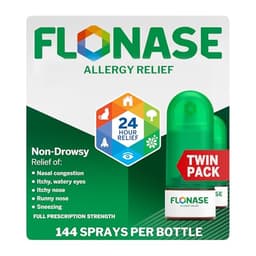
Flonase (fluticasone propionate)
Best For
First-line daily control of congestion, sneezing, and runny nose
Works In
Noticeable improvement by day 3; full effect over about 2 weeks of daily use
Price
$56.64
$0.20 / count
Pros
- ✓Strongest evidence base of any nasal spray class — outperforms oral antihistamines for nasal symptoms in systematic review
- ✓FDA-approved for once-daily, ongoing use with a long safety record
- ✓Treats congestion, sneezing, itching, and runny nose in a single spray
Cons
- ✗Not a same-day fix — needs several days of consistent use to build full effect
- ✗Local side effects like nasal dryness or occasional nosebleeds are possible with daily use
- ✗Technique matters — aiming the spray away from the septum reduces irritation
We earn 1-4%/sale if you sign up · See all commissions
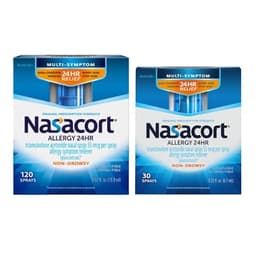
Nasacort Allergy 24HR (triamcinolone acetonide)
Best For
Same-class alternative to Flonase — scent-free formulation
Works In
Noticeable improvement by day 3-7; full effect with continued daily use
Price
$28.99
$0.19 / count
Pros
- ✓Same intranasal corticosteroid class as Flonase, with comparable trial-level evidence against oral antihistamines
- ✓Scent-free and alcohol-free formulation — a common reason people switch from Flonase
- ✓Once-daily dosing, approved for ongoing seasonal and year-round use
Cons
- ✗Same days-to-full-effect timeline as any steroid spray — not a rescue option
- ✗Some users report more dripping down the throat than with Flonase
- ✗Requires daily consistency; skipped days delay the benefit
We earn 1-4%/sale if you sign up · See all commissions
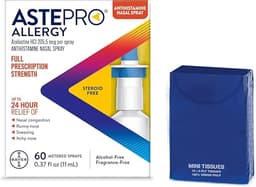
Astepro Allergy (azelastine)
Best For
Fast-acting relief — as-needed use or when a steroid alone isn't enough
Works In
About 30 minutes
Price
$17.48
$0.29 / count
Pros
- ✓One of the fastest-acting nasal sprays available OTC — a controlled exposure-chamber trial documented measurable relief within 30 minutes
- ✓First intranasal antihistamine to switch from prescription to OTC status in the U.S.
- ✓Combining it with a steroid spray outperforms either ingredient alone in trial data — a reasonable next step if Flonase or Nasacort isn't fully controlling symptoms
Cons
- ✗Standalone long-term-control evidence is thinner than the steroid class
- ✗A bitter aftertaste is a common, if minor, complaint
- ✗Some users report mild drowsiness despite it being a nasal, not oral, antihistamine
We earn 1-4%/sale if you sign up · See all commissions
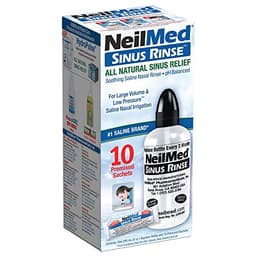
NeilMed Sinus Rinse
Best For
Drug-free daily add-on that physically flushes allergens and mucus
Works In
Immediate mechanical relief; no drug effect to build
Price
$13.43
$13.43 / count
Pros
- ✓A Cochrane systematic review found saline irrigation improves nasal symptom scores in allergic rhinitis with minimal risk
- ✓No rebound risk, no drug interactions, safe for daily long-term use
- ✓Pairs well with a steroid or antihistamine spray rather than replacing either
Cons
- ✗Doesn't treat the underlying allergic inflammation — mechanical relief only
- ✗Requires distilled, sterile, or previously boiled water — tap water carries a small infection risk
- ✗Takes a minute or two longer per use than a metered spray
We earn 1-4%/sale if you sign up · See all commissions
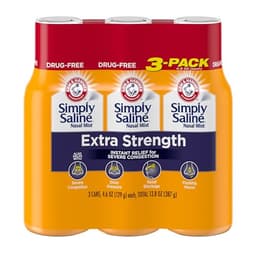
Generic Saline Nasal Spray
Best For
Quick, portable saline moisture — less flushing power than a full rinse
Works In
Immediate
Price
$19.56
$1.42 / ounce
Pros
- ✓Convenient, no-prep alternative to a rinse bottle for on-the-go use
- ✓No rebound risk and no age restrictions — safe for kids and adults alike
- ✓Useful for dryness from indoor heating or air travel, not just allergy season
Cons
- ✗Delivers far less volume than a squeeze-bottle or neti-style rinse, so it flushes allergens less thoroughly
- ✗Not a substitute for a steroid or antihistamine spray if congestion is more than mild
- ✗Effect is brief — more of a top-up than a standalone allergy tool
We earn 1-4%/sale if you sign up · See all commissions
Amazon prices retrieved from the Amazon Product Advertising API on . Prices and availability are accurate as of that time and may change.
For a deeper side-by-side of the two steroid sprays plus Astepro, see our Flonase vs. Nasacort vs. Astepro comparison. If you're deciding between a saline spray and a full sinus-rinse system, our Navage vs. NeilMed comparison goes deeper on that specific decision.
Is Flonase Safe to Use Every Day?
Yes — and this is worth stating plainly, because "steroid" in the name makes some people wary of daily use. Fluticasone propionate is FDA-approved specifically for once-daily, ongoing dosing, and it works at the local tissue level in the nose rather than circulating through the body the way an oral steroid does. Intranasal corticosteroids as a class have a long track record of use in trials lasting months, not days, including in children PMID: 19441606. The realistic downsides of daily use are local and generally mild: nasal dryness, occasional light nosebleeds (usually from spraying straight at the septum rather than angled outward), and a bitter taste if some spray drips down the throat. Inconsistent use — not daily use — is the more common mistake, since it resets the days-to-effect clock covered next.
How Long Does Flonase Take to Work?
This is the single most common point of frustration with steroid nasal sprays, and it's worth setting expectations honestly rather than letting the "instant relief" framing on some packaging set the wrong bar. A dose-ranging, placebo-controlled trial of fluticasone propionate in 423 adults with moderate-to-severe seasonal allergic rhinitis found meaningful symptom improvement was evident within 3 days of starting daily use PMID: 2200821, and a dedicated review of intranasal corticosteroid onset-of-action studies confirms that pattern generally: some patients notice partial relief within the first day, but full, stable symptom control across the whole spray class builds over roughly the first two weeks of uninterrupted daily dosing PMID: 20031006.
The practical takeaway: if you start Flonase or Nasacort the morning of a big pollen day expecting relief within the hour, you'll likely be disappointed and may conclude — wrongly — that the product "doesn't work." Steroid sprays reward starting early and using consistently, ideally a few days before a predictable high-pollen stretch, and continuing daily through the season rather than stopping once symptoms ease.
Steroid vs. Antihistamine Nasal Spray: Which Should You Use First?
For most people with ongoing, day-after-day allergy congestion, an intranasal steroid is the better starting point — it has the deeper, more consistent evidence base for nasal symptom control specifically PMID: 9848901 PMID: 39251016. But azelastine (Astepro) fills a real gap that a steroid spray doesn't: speed. A controlled environmental-exposure-chamber trial measuring azelastine's onset of action found measurable symptom relief within about 30 minutes of dosing PMID: 39067509, consistent with earlier pharmacology reviews describing an onset around 15 minutes PMID: 20477689 — a timeline no steroid spray can match.
That makes azelastine the better fit for occasional exposure (visiting a friend's house with a cat, an unexpectedly high-pollen day you didn't plan for) rather than as a sole daily strategy. It's also a legitimate add-on, not just an alternative: trial data on combining an intranasal antihistamine with an intranasal steroid found the combination reduced nasal symptom scores more than either ingredient used alone PMID: 30961435. If Flonase or Nasacort by itself isn't fully controlling your symptoms after a genuine multi-week trial, adding Astepro — rather than switching or doubling the steroid dose — is the evidence-backed next step, ideally discussed with a pharmacist or allergist first.
Nasal Spray for Allergies Without Rebound Congestion
Every spray ranked above is safe for daily, indefinite use. That's not true of the fourth major category sold in the same store aisle: decongestant sprays like Afrin (oxymetazoline). They work almost immediately, by constricting blood vessels in the nasal lining, which is exactly why they're tempting to reach for during a bad allergy day. It's also exactly the mechanism behind the reason they don't belong in a long-term allergy routine.
Used beyond about 3 consecutive days — the standard clinical and product-label guidance for oxymetazoline sprays — decongestant sprays can trigger rhinitis medicamentosa: a rebound cycle in which the nasal lining's blood vessels become dependent on the drug to stay constricted, so congestion returns worse than the original symptoms once the spray wears off, prompting another dose, and another, in an escalating pattern. Breaking the cycle typically means stopping the decongestant entirely, riding out a rough stretch of rebound congestion, and bridging with a steroid spray — or, in stubborn cases, a short course of oral steroids under a doctor's supervision.
Allergy congestion is a weeks-to-months problem, not a 3-day one — the wrong match for a drug that's only safe to use for 3 days at a time. That mismatch is why none of the products ranked above are decongestant sprays, and why a steroid, antihistamine, or saline option is the safer default even on a bad symptom day.
Saline Rinses: The Low-Risk Daily Add-On
Saline nasal sprays and rinses contain no active drug — just isotonic salt water — and they work by mechanically flushing pollen, dust, and mucus out of the nasal passages rather than altering the allergic response itself. A Cochrane systematic review found that saline irrigation improved nasal symptom scores in people with allergic rhinitis, with a favorable safety profile and minimal downside PMID: 29932206. Because the mechanism is purely mechanical, it layers safely on top of a steroid or antihistamine spray rather than competing with it — many people rinse first to clear the passages, then use their medicated spray a few minutes later so it has better contact with the nasal lining.
The one real caution: use distilled, sterile, or previously boiled-and-cooled water in a rinse bottle, never straight tap water, since rare but serious infections have been linked to tap-water use in nasal rinse devices.
How to Choose
If your congestion is a daily, ongoing problem through pollen season or year-round, start with an intranasal steroid — Flonase or Nasacort — used every morning, and give it a full week before judging whether it's working. For faster relief on an unpredictable or occasional exposure, keep Astepro on hand, or add it to your steroid spray if that alone isn't cutting it after a fair trial. Layer a saline rinse on top of either — it's close to risk-free and genuinely helps. And resist reaching for a decongestant spray like Afrin beyond an occasional 2-3 day stretch (a bad cold, a short flight), since allergy season lasts far longer than rhinitis medicamentosa takes to set in.
For the full picture of how nasal sprays fit alongside oral antihistamines and eye drops in a complete allergy plan, see our seasonal allergies survival guide and our ranking of the best allergy medicines.
Frequently Asked Questions
Is Flonase safe to use every day? Yes. Fluticasone propionate is FDA-approved for once-daily, ongoing use, and intranasal corticosteroids as a class have a long safety record at labeled OTC doses. The main daily-use side effects are local — nasal dryness or occasional nosebleeds — not the systemic risks associated with oral steroids.
How long does Flonase take to work? Some people notice partial relief within hours, but intranasal corticosteroids are built for consistent daily use, not as-needed dosing — dose-ranging trial data shows meaningful improvement by day 3, with full effect continuing to build over roughly two weeks of uninterrupted use.
What's a nasal spray for allergies that won't cause rebound congestion? Steroid sprays (Flonase, Nasacort), antihistamine sprays (Astepro), and saline rinses (NeilMed) are all safe for daily, ongoing use without rebound. Only decongestant sprays containing oxymetazoline (Afrin) cause rebound congestion, and those shouldn't be used beyond about 3 days.
Should I use a steroid spray or an antihistamine spray? For daily, ongoing congestion, an intranasal steroid like Flonase or Nasacort has the stronger evidence base and is the standard first-line choice. An antihistamine spray like Astepro works within about 30 minutes, making it a better fit for occasional symptoms or as an add-on.
Can you use Flonase and Astepro together? Yes — combining an intranasal steroid with an intranasal antihistamine is a recognized next step when either alone isn't controlling symptoms well enough, and trial data shows the combination outperforms either ingredient by itself. Space the two sprays a few minutes apart.
Why shouldn't I use Afrin for allergies? Afrin and other oxymetazoline decongestant sprays work fast, but using one for more than about 3 consecutive days risks rhinitis medicamentosa — a rebound cycle where congestion returns worse than before each time the drug wears off. Allergy congestion lasts far longer than 3 days, so a steroid, antihistamine, or saline spray is the safer daily tool.
References
- Weiner JM, Abramson MJ, Puy RM. Intranasal corticosteroids versus oral H1 receptor antagonists in allergic rhinitis: systematic review of randomised controlled trials. BMJ. 1998;317(7173):1624-1629. PMID: 9848901.
- Torres MI, Gil-Mata S, Bognanni A, et al; Allergic Rhinitis and its Impact on Asthma 2024 Guideline Panel. Intranasal Versus Oral Treatments for Allergic Rhinitis: A Systematic Review With Meta-Analysis. Journal of Allergy and Clinical Immunology: In Practice. 2024;12(12):3404-3418. PMID: 39251016.
- Meltzer EO, Orgel HA, Bronsky EA, et al. A dose-ranging study of fluticasone propionate aqueous nasal spray for seasonal allergic rhinitis assessed by symptoms, rhinomanometry, and nasal cytology. Journal of Allergy and Clinical Immunology. 1990;86(2):221-230. PMID: 2200821.
- Katial RK, Salapatek AM, Patel P. Establishing the onset of action of intranasal corticosteroids: is there an ideal study design? Allergy and Asthma Proceedings. 2009;30(6):595-604. PMID: 20031006.
- Weinstein S, Qaqundah P, Georges G, et al. Efficacy and safety of triamcinolone acetonide aqueous nasal spray in children aged 2 to 5 years with perennial allergic rhinitis. Annals of Allergy, Asthma & Immunology. 2009;102(4):339-347. PMID: 19441606.
- Horak F, Zieglmayer UP. Azelastine nasal spray for the treatment of allergic and nonallergic rhinitis. Expert Review of Clinical Immunology. 2009;5(6):659-669. PMID: 20477689.
- Hsu SN, Sajjad F, Brigham E, et al. Onset of efficacy of azelastine hydrochloride 0.15% nasal spray for allergic rhinitis in an environmental exposure chamber. Annals of Allergy, Asthma & Immunology. 2024;133(6):675-681. PMID: 39067509.
- Debbaneh PM, Bareiss AK, Wise SK, McCoul ED. Intranasal Azelastine and Fluticasone as Combination Therapy for Allergic Rhinitis: Systematic Review and Meta-analysis. Otolaryngology-Head and Neck Surgery. 2019;161(3):412-418. PMID: 30961435.
- Head K, Snidvongs K, Glew S, et al. Saline irrigation for allergic rhinitis. Cochrane Database of Systematic Reviews. 2018;6(6):CD012597. PMID: 29932206.