Flonase, Nasacort, and Astepro sit next to each other on the same drugstore shelf, and most people grab whichever one is cheapest or most familiar that week. That's usually fine — but the three sprays aren't interchangeable. Two of them (Flonase and Nasacort) are the same drug class working the same way; the third (Astepro) is a fundamentally different mechanism with its own speed and symptom profile. Knowing which is which changes how you should actually use them, including whether combining two of them makes sense.
This article is for general education and isn't a substitute for advice from your own physician or pharmacist.
Quick Answer
Flonase (fluticasone) and Nasacort (triamcinolone) are both steroid sprays with comparable head-to-head trial results — pick based on scent and formulation preference. Astepro (azelastine) is a faster-acting antihistamine spray, better for sudden flare-ups; combining it with a steroid spray has real trial support for people whose symptoms don't fully respond to either alone.
Two Drug Classes, One Shelf
Flonase and Nasacort are both intranasal corticosteroids (INCS) — they reduce the inflammatory cascade that drives allergic rhinitis, which is why they cover the full symptom set: congestion, runny nose, sneezing, and itching. Their tradeoff is speed: they need days of consistent daily use to reach full effect, even though some people notice partial relief within the first few hours.
Astepro is a different mechanism entirely. Azelastine is an intranasal antihistamine, blocking histamine receptors directly rather than damping inflammation broadly. That makes it fast — a controlled environmental-exposure-chamber trial found azelastine produced a statistically significant improvement in total nasal symptom score within 15 minutes of dosing, sustained for hours afterward PMID: 17882923 — but antihistamines generally have a narrower effect on congestion than steroids do, since congestion is driven by more than histamine alone.
Flonase vs Nasacort: Which Is Better?
Functionally, not much separates them. A randomized trial comparing triamcinolone acetonide aerosol against fluticasone propionate in spring allergic rhinitis found no statistically significant difference in symptom score reduction between the two PMID: 9389286. A separate trial in seasonal allergic rhinitis reached the same conclusion — the two drugs produced equivalent improvement in both individual nasal symptom scores and total nasal symptom score, with no meaningful difference between them PMID: 12869911. A more recent randomized, parallel-group trial in perennial (year-round) allergic rhinitis confirmed triamcinolone was non-inferior to fluticasone for symptom control PMID: 30879006. Fluticasone has higher receptor-binding affinity in laboratory measures, but none of these trials found that translating into a meaningfully better clinical result.
So the real differences are practical, not pharmacological:
- Formulation. Nasacort is an alcohol-free, virtually scent- and taste-free suspension. Flonase uses an aqueous base with a faint scent that some users notice as a brief sting or aftertaste.
- Age labeling. Nasacort's OTC label covers ages 2 and up; Flonase's covers ages 4 and up.
- Eye symptoms. Flonase's OTC indication explicitly covers itchy, watery eyes alongside nasal symptoms; Nasacort's label doesn't include an eye-symptom claim, so if allergy eyes are a big part of your problem, Flonase (or a separate eye drop) has the edge.
Comparison Table
| Flonase | Nasacort | Astepro | |
|---|---|---|---|
| Drug class | Fluticasone propionate (INCS) | Triamcinolone acetonide (INCS) | Azelastine (antihistamine) |
| Onset | 3-7 days for full effect; partial relief in hours | 3-7 days for full effect; partial relief in hours | As fast as 15-30 minutes |
| Best-for symptoms | Congestion, sneezing, runny/itchy nose, plus itchy/watery eyes | Congestion, sneezing, runny/itchy nose (no eye-symptom claim) | Sudden flare-ups; sneezing and itching more than congestion |
| Scent / taste | Faint scent; mild aftertaste or sting for some users | Alcohol-free, virtually scent- and taste-free | Bitter aftertaste is a common complaint |
| Age labeling (OTC) | 4 years and up | 2 years and up | 6 years and up (0.15% OTC strength) |
| Typical cost | ~$20/mo | ~$18/mo | ~$22/mo |
Astepro vs Flonase for Congestion
If congestion — that stuffed, can't-breathe-through-your-nose feeling — is your dominant symptom, the steroid sprays have the stronger track record. Corticosteroids act on a broader set of inflammatory mediators that drive tissue swelling in the nasal passages, which is the mechanical cause of congestion; antihistamines like azelastine target histamine specifically, which plays a bigger role in sneezing and itching than in congestion itself. That's consistent with why Flonase's OTC labeling and its trial history lean on comprehensive nasal-symptom relief, while Astepro's marketing and trial data lean on speed.
That doesn't make Astepro a poor choice for congestion — it still helps, and its fast onset PMID: 17882923 makes it genuinely useful for a same-day flare-up when you don't have days to wait for a steroid spray to build up. The practical pattern many people land on: Astepro for the next few hours of relief, a steroid spray (Flonase or Nasacort) started at the same time for the congestion that steroids handle better once they kick in.
If nasal sprays generally aren't cutting it, our roundup of the best nasal sprays for allergies covers more options side by side, and our guide to seasonal allergies covers the broader symptom picture beyond just the nose.
Can You Use Flonase and Astepro Together?
Yes — and this isn't an off-label workaround, it's a studied combination. Using an intranasal antihistamine alongside an intranasal steroid is a recognized step up in allergic rhinitis treatment. A systematic review and meta-analysis of trials combining intranasal azelastine and fluticasone found a consistently greater reduction in patient-reported symptom scores with the combination compared to either drug alone or placebo PMID: 30961435. A separate meta-analysis specifically evaluating the branded combination formulation, MP-AzeFlu, found it superior to placebo and to azelastine monotherapy on total nasal symptom score PMID: 34415405.
The honest framing here matters: this evidence is about a combination outperforming monotherapy, not about everyone needing both. For most people with typical seasonal or perennial allergic rhinitis, a single well-chosen intranasal steroid — Flonase or Nasacort, used consistently — controls symptoms adequately on its own. The combination approach is most clearly supported for people whose symptoms are moderate-to-severe and don't fully resolve on one spray alone, which is also how it's positioned clinically — as a second-line step, not a first move. If you're combining two nasal sprays, use them as directed (typically one spray of each per nostril, and it's worth checking with a pharmacist on exact timing), and don't assume more sprays automatically means more relief.
If your congestion is tied more to chronic sinus or indoor-air triggers than seasonal pollen, our mold and indoor air guide digs into that side of chronic congestion, and if you're also curious whether a saline rinse belongs in the routine alongside a spray, see Navage vs. NeilMed.
Our Picks
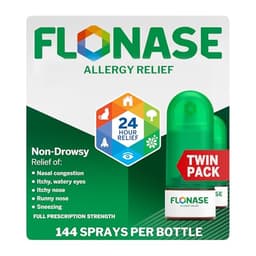
Flonase Allergy Relief (fluticasone propionate)
Best For
Daily, consistent control of congestion, sneezing, and runny/itchy eyes
Works In
3-7 days for full effect; some relief within hours
Price
$56.64
$0.20 / count
Pros
- ✓Broadest symptom coverage of the three, including an OTC eye-symptom indication
- ✓Head-to-head trials show equivalent efficacy to Nasacort for nasal symptoms
- ✓Well-established daily-use safety record
Cons
- ✗Takes several days of consistent use to reach full effect
- ✗Faint scent and mild aftertaste bother some users
- ✗OTC labeling starts at age 4, not 2
We earn 1-4%/sale if you sign up · See all commissions
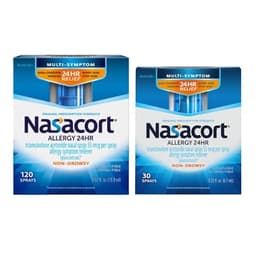
Nasacort Allergy 24HR (triamcinolone acetonide)
Best For
Same steroid-class relief in an alcohol-free, scent-free formula
Works In
3-7 days for full effect; some relief within hours
Price
$28.99
$0.19 / count
Pros
- ✓Virtually undetectable scent and taste — a common tie-breaker for sensitive users
- ✓Trials find equivalent symptom control to fluticasone in both seasonal and perennial allergic rhinitis
- ✓OTC labeling covers ages 2 and up, the youngest of the three
Cons
- ✗No OTC eye-symptom indication
- ✗Still takes days to reach full effect, like any INCS
- ✗Requires priming before first use each season
We earn 1-4%/sale if you sign up · See all commissions
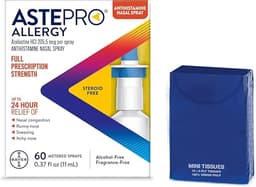
Astepro Allergy (azelastine 0.15%)
Best For
Fast relief for sudden flare-ups, or as an add-on when a steroid spray alone isn't enough
Works In
As fast as 15-30 minutes
Price
$17.48
$0.29 / count
Pros
- ✓Fastest onset of the three by a wide margin, confirmed in exposure-chamber trials
- ✓Combination with a steroid spray has meta-analysis-level evidence of added benefit for inadequate responders
- ✓No priming delay before first use
Cons
- ✗Bitter aftertaste is a frequently reported complaint
- ✗Can cause mild drowsiness in some users, unlike the steroid sprays
- ✗Generally a weaker standalone option for congestion specifically than an INCS
We earn 1-4%/sale if you sign up · See all commissions
Amazon prices retrieved from the Amazon Product Advertising API on . Prices and availability are accurate as of that time and may change.
How to Choose
- Congestion is your main problem, and you want set-it-and-forget-it daily relief: start with Flonase or Nasacort. Pick Nasacort if scent/taste sensitivity is a concern or you need a product labeled for a child as young as 2; pick Flonase if itchy, watery eyes are part of your symptom pattern.
- You need relief today, not in three days: Astepro's faster onset makes it the better immediate option, understanding it may not fully control congestion on its own.
- You've tried a steroid spray consistently for two-plus weeks and it's still not enough: adding Astepro is a reasonable, evidence-supported next step rather than switching between steroid sprays or increasing the dose beyond the label.
Safety Notes
All three are generally well tolerated with consistent, correct use — spray toward the outer wall of the nostril, away from the septum, to minimize the most common steroid-spray side effect (nasal irritation or occasional nosebleeds). Azelastine's most distinct side effects are a bitter taste after dosing and, in some users, drowsiness — worth knowing before you drive or operate machinery shortly after a dose. None of these three sprays are a substitute for medical evaluation if symptoms are severe, one-sided, accompanied by facial pain or fever (which can suggest a sinus infection rather than allergies), or don't improve after a full, consistent trial of a couple of weeks.
Frequently Asked Questions
Flonase vs Nasacort: which is better? Head-to-head trials find them equally effective for nasal symptom relief. The real differences are formulation (Nasacort is scent-free) and minimum age (Nasacort from age 2, Flonase from age 4), not efficacy.
Is Astepro or Flonase better for congestion? Flonase and other intranasal steroids generally have the edge for congestion specifically with consistent use, while Astepro's azelastine works faster but is considered somewhat weaker for congestion on its own.
Can you use Flonase and Astepro together? Yes — combining an intranasal antihistamine with an intranasal steroid is a studied approach, and meta-analyses of the combination find it outperforms either drug alone, particularly for people whose symptoms aren't fully controlled on one spray.
How fast does Astepro work compared to Flonase or Nasacort? Astepro can show measurable improvement within 15 to 30 minutes in controlled trials. Flonase and Nasacort need several days of consistent daily use to reach full effect.
Can children use Nasacort, Flonase, or Astepro? Current OTC labeling allows Nasacort from age 2, Flonase from age 4, and Astepro Allergy (0.15%) from age 6. Check the specific product label and ask a pediatrician for younger children.
Do I need a prescription for Flonase, Nasacort, or Astepro? No, all three are available over the counter at their standard strengths in the U.S.
References
- Small P, Houle PA, Day JH, et al. A comparison of triamcinolone acetonide nasal aerosol spray and fluticasone propionate aqueous solution spray in the treatment of spring allergic rhinitis. Journal of Allergy and Clinical Immunology. 1997;100(5):592-595. PMID: 9389286.
- Berger WE, Kaiser H, Gawchik SM, Tillinghast J, Woodworth TH, Dupclay L, Georges GC. Triamcinolone acetonide aqueous nasal spray and fluticasone propionate are equally effective for relief of nasal symptoms in patients with seasonal allergic rhinitis. Otolaryngology–Head and Neck Surgery. 2003;129(1):16-23. PMID: 12869911.
- Karaulov AV, Vylegzhanina T, Ovchinnikov A, Chernikova M, Nenasheva N. Triamcinolone Acetonide versus Fluticasone Propionate in the Treatment of Perennial Allergic Rhinitis: A Randomized, Parallel-Group Trial. International Archives of Allergy and Immunology. 2019;179(2):142-151. PMID: 30879006.
- Patel P, D'Andrea C, Sacks HJ. Onset of action of azelastine nasal spray compared with mometasone nasal spray and placebo in subjects with seasonal allergic rhinitis evaluated in an environmental exposure chamber. American Journal of Rhinology. 2007;21(4):499-503. PMID: 17882923.
- Debbaneh PM, Bareiss AK, Wise SK, McCoul ED. Intranasal Azelastine and Fluticasone as Combination Therapy for Allergic Rhinitis: Systematic Review and Meta-analysis. Otolaryngology–Head and Neck Surgery. 2019;161(3):412-418. PMID: 30961435.
- Zhong Z, Xun Y, Shi X, Guan B, Wang M. Clinical efficacy and safety of MP-AzeFlu for the treatment of allergic rhinitis: a meta-analysis. European Archives of Oto-Rhino-Laryngology. 2022;279(5):2457-2464. PMID: 34415405.