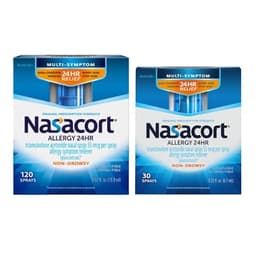
What Nasacort is
Nasacort Allergy 24HR is triamcinolone acetonide, an intranasal corticosteroid (steroid spray). Each spray delivers 55 mcg. It's the same drug class as Flonase. The formula is unscented and alcohol-free.
The item we link to is the Nasacort 24HR Allergy Nasal Spray. Amazon lists it as "for Adults", but the label covers children from age 2.
Dosing by age:
- Adults and children 12+: 2 sprays per nostril once a day, then 1 spray per nostril once symptoms are controlled.
- Children 6 to 11: 1 spray per nostril once a day, increased to 2 only if needed, with an adult helping.
- Children 2 to 5: 1 spray per nostril once a day, given by an adult.
How well it works
Steroid sprays are the most effective single maintenance treatment for allergic rhinitis. A systematic review of 16 randomized trials found they relieved nasal blockage, runny nose, sneezing and itch better than oral antihistamines PMID: 9848901. A later meta-analysis agreed PMID: 28234147.
Nasacort holds its own against Flonase. In a randomized trial in seasonal allergies, triamcinolone and fluticasone produced equivalent drops in nasal symptom scores and similar gains in quality of life PMID: 12869911. A 2019 randomized trial in year-round allergies found triamcinolone non-inferior to fluticasone, with similar side effect rates PMID: 30879006.
The catch is timing. Like every steroid spray, Nasacort builds up over several days of daily use. Some people notice a little relief on the first day. Start it a few days before your pollen season if you can, and keep using it daily.
What it treats well: congestion, runny nose, sneezing and nasal itch.
What it doesn't do: work within the hour, or treat eye symptoms (its label doesn't claim to). For fast relief, Astepro acts in about 30 minutes.
How to use it, and side effects
- Shake and prime the bottle as the label directs before first use.
- Blow your nose first. Tilt your head slightly forward.
- Aim away from the septum, toward the outer wall of the nostril.
- Sniff gently so the spray stays in your nose.
Common side effects are local: dryness, irritation and nosebleeds. Aiming away from the septum prevents most of them. If nosebleeds keep happening, stop and talk to a clinician.
For young children, there's trial data. In a randomized trial of 474 children aged 2 to 5, triamcinolone had side effect rates similar to placebo. Some children continued for up to six months. By the end of the study there was no significant change in adrenal function tests, and growth percentiles stayed stable PMID: 19441606. The label still warns that steroid sprays may slow growth in some children. Use the lowest dose for the shortest time, and talk to your child's doctor if they need it for more than two months a year.
Ask a clinician first if you have glaucoma, cataracts, a recent nose injury or surgery, or are pregnant or breastfeeding.
Nasacort vs. Flonase
Same effectiveness, different details:
- Scent: Nasacort is unscented and alcohol-free. Flonase has a floral scent.
- Age: Nasacort is labeled from age 2. Flonase is labeled from age 4.
- Eyes: Flonase's label covers itchy, watery eyes. Nasacort's doesn't.
If you've used Flonase and disliked the smell or the sting, Nasacort is the obvious switch.
Who should buy it
Buy Nasacort if you want a daily steroid spray for congestion and prefer an unscented formula, or you need one for a child aged 2 or older.
Choose Flonase instead if itchy, watery eyes are a big part of your symptoms.
Add Astepro if you need faster relief. For more options, see our best nasal sprays for allergies.