Nasal irrigation has some of the more genuinely solid evidence of any over-the-counter allergy add-on — but the two most-searched devices for doing it, Navage and NeilMed, work on completely different mechanisms and completely different cost structures. One is a powered countertop unit with proprietary salt pods; the other is a squeeze bottle you can refill with a homemade saline mix for pennies. This guide compares them head-to-head on mechanism, cost, and mess, is honest about what the evidence does and doesn't say about picking one over the other, and covers the water-safety rule that matters more than either brand.
This article is for general education and isn't a substitute for advice from your own physician or ENT.
Quick Answer
Navage uses powered suction for a faster, less messy rinse; NeilMed's squeeze bottle costs far less per rinse and can use homemade saline. Neither device is clinically superior — irrigation itself has real evidence for congestion relief — so it comes down to budget and mess tolerance. Never use tap water.
How Navage and NeilMed Actually Work
Navage is a battery-powered countertop device. You lean over its two-part tank, place a nozzle in each nostril, and press a button — the unit actively suctions saline through one nostril and out the other, pulling mucus and irritants into a lower waste chamber rather than letting the solution drain into a sink. It runs on proprietary pre-measured SaltPods, one per rinse, mixed automatically with water from the upper tank.
NeilMed Sinus Rinse is a manual squeeze bottle. You mix a premixed saline packet (or a homemade salt-and-baking-soda solution) with properly prepared water, tilt your head over a sink, and squeeze — positive pressure pushes the saline in one nostril and out the other or your mouth. It's the same basic gravity/pressure principle as a classic neti pot, just with a squeeze bottle instead of a spouted pot for more controlled pressure.
Both approaches rinse the nasal cavity with an isotonic or slightly hypertonic saline solution; they just differ in how the fluid gets moved through your nose.
Navage vs. NeilMed: Side-by-Side Comparison
| Feature | Navage | NeilMed Sinus Rinse |
|---|---|---|
| Mechanism | Powered suction — pulls saline through automatically | Manual squeeze bottle — you control the pressure |
| Upfront cost | Roughly $70-100 for the device + starter SaltPods | Roughly $13-17 for a bottle + starter packets |
| Cost per rinse | ~$0.50-0.60 per proprietary SaltPod | ~$0.10-0.15 per premixed packet, or pennies with homemade saline |
| Ease / mess | Faster (~30 seconds), less lean-over-the-sink drainage | Requires leaning over a sink; more technique-dependent |
| Maintenance | Two-chamber tank and nozzle need regular cleaning and full drying; requires batteries/charging | Simple bottle and cap — easier to fully clean and dry, no battery |
Our Picks
Neither device is "the winner" in a clinical sense — see the evidence section below — so these picks reflect what each is actually best suited for.
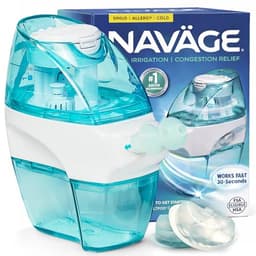
Navage Nasal Care Starter Bundle
Best For
People who want the fastest, least messy rinse and don't mind paying more per use
Works In
About 30 seconds per rinse
Price
$99.88
$99.88 / count
Pros
- ✓Powered suction completes a full rinse in seconds with minimal sink-side mess
- ✓Pre-measured SaltPods remove any guesswork or mixing error
- ✓Two-chamber design keeps used solution separate from clean saline
Cons
- ✗Meaningfully higher ongoing cost than any squeeze-bottle system
- ✗Requires charging/batteries and more parts to clean and dry between uses
- ✗Some users report the pump losing suction strength after the warranty period
We earn 1-4%/sale if you sign up · See all commissions
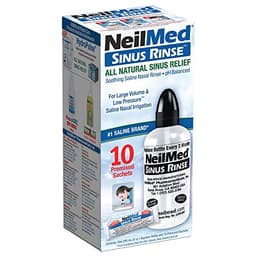
NeilMed Sinus Rinse Kit
Best For
People who want the lowest cost per rinse and don't mind the sink-side routine
Works In
1-2 minutes per rinse
Price
$13.45
$13.45 / count
Pros
- ✓A fraction of the ongoing cost of a powered system, especially with bulk packet refills
- ✓Simple bottle design is easy to fully clean and air-dry between uses
- ✓No batteries, charging, or moving parts to fail
Cons
- ✗Manual squeeze technique takes a rinse or two to get comfortable with
- ✗More prone to drips and spillover than a suction-based system
- ✗Requires leaning over a sink, which some people find awkward
We earn 1-4%/sale if you sign up · See all commissions
Amazon prices retrieved from the Amazon Product Advertising API on . Prices and availability are accurate as of that time and may change.
Does Nasal Irrigation Actually Work? What the Evidence Shows
This is the honest part: the evidence supports saline nasal irrigation as a category, not Navage or NeilMed specifically. No published trial has compared the two devices head-to-head for symptom relief, so any claim that one "works better" than the other is marketing, not data — what's been tested is saline irrigation as a technique, delivered by whatever bottle, pot, or pump the study used.
On that broader question, the evidence is genuinely decent. A Cochrane systematic review of saline irrigation for allergic rhinitis, covering 14 trials and 747 participants, found that nasal saline irrigation improved allergic rhinitis symptoms compared with no irrigation, in both adults and children, without notable adverse effects — though the review authors rated the overall certainty of evidence as low to very low because the included trials were small and used varied outcome measures PMID: 29932206. A separate Cochrane review focused on chronic rhinosinusitis found that daily, large-volume saline irrigation had some benefit over placebo for sinus symptoms, again with low-certainty evidence PMID: 27115216.
The practical read: irrigation is a reasonable, low-risk adjunct to your regular allergy treatment — not a replacement for an intranasal corticosteroid if you have ongoing allergic rhinitis, and not something with strong enough evidence to justify a premium device purely on efficacy grounds. If a nasal spray is your main treatment, our nasal spray comparison guide and Flonase vs. Nasacort vs. Astepro breakdown cover that side of the medicine cabinet.
Navage vs. Neti Pot: Which Is Better?
A classic neti pot and NeilMed's squeeze bottle work on the same basic principle — gravity or manual pressure pushing saline through the nose — so the real comparison here is "powered suction vs. gravity/pressure," not brand-specific. Navage's suction pulls solution through automatically and drains it into a separate chamber, which most people find faster and less prone to the drips and spillover that come with tilting your head over a sink with a pot or bottle. That convenience is real, and it's the main reason people upgrade to a powered system.
What a neti pot (or NeilMed) has going for it is cost and simplicity: no batteries, no proprietary refill, and the option to mix your own saline with the same measured salt-and-baking-soda ratio at essentially no ongoing cost. Since neither approach has demonstrated superior symptom relief in controlled research, "which is better" mostly comes down to whether you'd rather pay more upfront and per rinse for speed and less mess, or spend a bit more time and technique for a system that costs pennies to keep running.
Is Navage Worth It?
It's worth it for people who want the fastest, least fussy rinse and are willing to pay for that: roughly $70-100 for the starter bundle and about $0.50-0.60 per SaltPod afterward, with no ability to substitute a cheaper saline source. It's a harder sell if you're comparing it to a squeeze bottle purely on results, since the underlying clinical evidence is about saline irrigation generally, not this specific device — a $15 NeilMed kit delivers the same category of treatment for a fraction of the ongoing cost.
Navage also has more moving parts than a squeeze bottle — a pump, a battery or charging cable, two tank chambers — and more components means more that can eventually wear out or need warranty support.
Water Safety: Why You Should Never Use Tap Water
This matters more than which device you buy. Only use distilled water, water labeled sterile, or tap water that has been brought to a rolling boil for at least one minute (three minutes at elevations above roughly 6,500 feet) and then cooled to a comfortable temperature. Never irrigate your sinuses with water straight from the tap, a well, or any untreated source.
The reason is specific and serious. Municipal water treatment is designed to make water safe to drink, not to eliminate every organism that could be dangerous if it bypasses the stomach and enters directly through the nose. Some organisms, including the free-living amoeba Naegleria fowleri, can survive standard chlorination and, if introduced through the nasal passages, migrate along the olfactory nerve into the brain, where the resulting infection (primary amebic meningoencephalitis) is rare but usually fatal. A CDC-led investigation documented U.S. deaths directly traced to sinus irrigation performed with contaminated tap water PMID: 22919000, and a separate CDC field report describes a fatal case linked to nasal rinsing performed with improperly treated water PMID: 24226628 — this isn't a single isolated incident. The CDC and FDA guidance is unambiguous: distilled, sterile, or properly boiled-and-cooled water only, for any device — Navage, NeilMed, a neti pot, or anything else that puts water directly into your sinuses.
Rinse the device itself with distilled or previously boiled water too, and let every part air-dry fully between uses — a reservoir or tube that stays damp is a place for mold and bacteria to grow regardless of what water you used during the rinse.
How Often Can You Do a Sinus Rinse?
Once or twice a day is a reasonable routine during pollen season, a cold, or an allergy flare, and it's generally fine to use it more often — some clinicians say up to several times a day — for a few days when congestion is severe. Where the guidance gets more cautious is indefinite daily use: there's some concern that continuous long-term irrigation may wash away more of the nose's normal protective mucus layer than is ideal, so most specialists suggest stepping back to as-needed use once symptoms have settled rather than rinsing daily as a permanent habit. If you're using a rinse daily for more than a couple of weeks without real improvement, that's a reasonable point to check in with a doctor rather than just continuing indefinitely — persistent congestion can have causes irrigation alone won't fix, and it's exactly the kind of pattern covered in our mold and indoor air guide if a damp room is a plausible trigger.
Which One Should You Buy?
Bottom line: pick NeilMed (or a neti pot) for the lowest ongoing cost, and Navage for the least sink-side mess — that premium buys convenience, not better outcomes. Either way, treat irrigation as a companion to your regular allergy medication, not a replacement for it, and never put anything but distilled, sterile, or properly boiled-and-cooled water through either device.
Frequently Asked Questions
Is Navage better than NeilMed? Not clinically — no trial has shown powered suction beats a squeeze bottle for symptom relief. Navage is faster and less messy; NeilMed is far cheaper to run. The better choice depends on your budget and mess tolerance, not on superior evidence.
Navage vs neti pot: which is better? Navage rinses and drains faster with less sink-side mess. A neti pot (or NeilMed's squeeze bottle) costs far less to run and works with homemade saline. Both deliver the same underlying treatment.
Is Navage worth it? Worth it if fast, low-mess convenience is worth roughly $70-100 upfront and $0.50-0.60 per rinse to you. Not worth it if you're comparing it to a squeeze bottle purely on results — the evidence supports saline irrigation generally, not this specific device.
How often can you do a sinus rinse? Once or twice daily is reasonable during flares or a cold; step back to as-needed use once symptoms resolve rather than rinsing indefinitely every day.
Can I use tap water in a Navage or NeilMed? No. Use only distilled water, water labeled sterile, or tap water boiled at least one minute (three at higher elevations) and cooled. Untreated tap water can carry organisms, including Naegleria fowleri, that have caused fatal infections when introduced through the nose.
How do I clean my nasal irrigation device? Wash all parts with hot, distilled, or previously boiled water after each use and let everything air-dry completely before the next rinse — trapped moisture invites mold and bacteria regardless of the water used during irrigation.
References
- Head K, Snidvongs K, Glew S, et al. Saline irrigation for allergic rhinitis. Cochrane Database of Systematic Reviews. 2018;6(6):CD012597. PMID: 29932206.
- Chong LY, Head K, Hopkins C, et al. Saline irrigation for chronic rhinosinusitis. Cochrane Database of Systematic Reviews. 2016;4(4):CD011995. PMID: 27115216.
- Yoder JS, Straif-Bourgeois S, Roy SL, et al. Primary amebic meningoencephalitis deaths associated with sinus irrigation using contaminated tap water. Clinical Infectious Diseases. 2012;55(9):e79-85. PMID: 22919000.
- Centers for Disease Control and Prevention (CDC). Notes from the field: primary amebic meningoencephalitis associated with ritual nasal rinsing — St. Thomas, U.S. Virgin Islands, 2012. MMWR Morbidity and Mortality Weekly Report. 2013;62(45):903. PMID: 24226628.