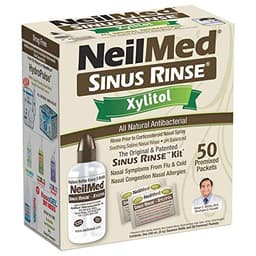
What it is
NeilMed Sinus Rinse is a squeeze bottle for nasal irrigation, plus premixed saline packets. You mix a packet with safe water, lean over a sink, and gently squeeze. The saline flows in one nostril and out the other.
The item we link to is the Sinus Rinse Kit with Xylitol, 50 count. Its packets add xylitol, a sugar alcohol, to the saline. The allergy evidence below is for saline rinses. We haven't found good allergy evidence for xylitol either way.
Typical use is once or twice a day, or after time outdoors. Follow the label's directions for children.
How well it works
A rinse doesn't treat the allergic reaction. It physically washes out pollen, dust and mucus.
The evidence is limited. A Cochrane review pooled 14 small randomized trials in adults and children with allergic rhinitis. Saline irrigation may reduce symptom severity compared with no saline, for up to three months, with no reported side effects. But the overall quality of evidence was low or very low PMID: 29932206.
The same review found it uncertain whether saline adds benefit on top of a steroid spray or allergy pill PMID: 29932206. So a rinse is a reasonable, cheap extra. It isn't a replacement for a steroid spray like Flonase, which has far stronger evidence.
What it's good for: clearing pollen after outdoor exposure, thick mucus, and preparing the nose for a medicated spray.
What it won't do: control moderate or severe allergy symptoms on its own.
Water safety: the rule you can't skip
Use only distilled, sterile, or boiled-and-cooled water. Never use water straight from the tap.
This isn't a theoretical risk. Tap water that's safe to drink can carry Naegleria fowleri, an amoeba that can travel from the nose to the brain. The infection is almost always fatal. In 2011, two people in Louisiana died after regular sinus rinsing with tap water; the amoeba was found in both homes' water PMID: 22919000. In 2012, a man in the U.S. Virgin Islands died after nasal rinsing with tap water as part of a religious practice PMID: 24226628.
Other tips:
- Clean the bottle after each use with safe water, and let it air-dry fully.
- Don't share your bottle.
- Skip rinsing and ask a clinician if you have an ear infection, blocked ears, or a fully blocked nose.
- A brief sting or feeling of water in the ears can happen, especially at first.
NeilMed vs. Navage
Both do the same basic job: flush saline through your nose. Navage uses powered suction and proprietary SaltPods. NeilMed uses a squeeze bottle and cheap packets.
No trials compare the two. The difference is cost and comfort. NeilMed costs about 10 to 15 cents per rinse after the kit. Navage costs about 50 to 60 cents per rinse, plus a much higher upfront price. Navage is less messy, which some people find easier to stick with.
Who should buy it
Buy NeilMed if you want a thorough, drug-free rinse for very little money and will reliably use safe water.
Choose Navage if you find squeeze bottles messy and will pay more for convenience.
Choose Simply Saline for a no-prep mist on the go. For the full comparison, see Navage vs NeilMed.