If your "cold" has lasted three weeks, always seems worse in the basement, and never quite turns into a fever, there's a reasonable chance it isn't a cold at all. Mold is one of the more under-recognized indoor allergy triggers — it doesn't announce itself the way a cat or a ragweed bloom does, and its symptoms overlap heavily with viral illness, which is why so many people go months without connecting the dots. This guide covers how to tell mold allergy apart from a cold, whether your home is the problem, the humidity target that stops mold from growing, when cleaning is enough versus when you need a professional, and which interventions actually have evidence behind them.
This article is for general education and isn't a substitute for a diagnosis or treatment plan from your own physician or allergist.
Quick Answer
Mold allergy causes the same runny nose and itchy eyes as other allergies, but it drags on for weeks and tracks with damp rooms, not a cold's 7-10 day course. Keeping humidity at 30-50% and fixing the moisture source have the most evidence — a nasal steroid and purifier help but don't fix the source.
What a Mold Allergy Actually Is
Mold releases spores as part of its normal reproductive cycle, and in people whose immune systems are sensitized to specific mold proteins, inhaling those spores triggers the same IgE-mediated allergic cascade that pollen or pet dander does — histamine release, inflamed nasal passages, itchy eyes, more mucus. Unlike pollen, mold can be a year-round indoor problem wherever there's moisture: bathrooms, basements, window sills, under sinks, HVAC systems, anything that's stayed damp more than a day or two.
That matters because mold allergy is largely a symptom of a moisture problem, not a condition you treat in isolation. A large body of research on damp buildings has found consistent associations between indoor dampness and mold and respiratory tract infections and bronchitis specifically, on top of the broader association between dampness and respiratory symptoms generally PMID: 21078183. A dedicated meta-analysis of indoor fungal exposure found that greater fungal diversity and load in the home is associated with higher odds of asthma PMID: 25159468. The medication and air-filtration sections below can reduce your symptoms, but the moisture source is what's actually driving the problem.
Mold Allergy Symptoms vs. a Cold: How to Tell the Difference
This is the single most common point of confusion, because mold allergy and a viral upper respiratory infection genuinely do overlap — runny nose, congestion, cough, sneezing, and a scratchy throat show up in both. A few practical differences usually separate them:
- Duration. Colds typically run their course in 7 to 10 days. Mold allergy symptoms persist for weeks to months as long as you're exposed.
- Fever and body aches. A cold is more likely to come with a low-grade fever, body aches, and a sick contact you can point to. Mold allergy typically doesn't cause fever.
- Contagion pattern. Colds spread through a household in a predictable wave. Mold allergy doesn't — if you're the only one affected, that favors allergy.
- Location and timing. The most useful clue: symptoms that worsen in a specific room (a basement, a bathroom, near a window with condensation) and ease when you're elsewhere.
- Itch. Itchy, watery eyes and an itchy throat point toward allergy; colds rarely cause noticeable itching.
A "cold" dragging past two weeks, that isn't contagious, and tracks a specific room in your house is worth treating as a possible mold allergy rather than waiting it out.
How to Tell If Mold Is Making You Sick
Beyond the cold-versus-allergy distinction, a few more specific signals point toward mold as the actual cause of ongoing symptoms:
- You can see or smell it. Visible growth (often black, green, or white and fuzzy or slimy) or a persistent musty odor is the most direct evidence. Mold often grows in places you don't look — behind furniture against exterior walls, under carpet padding, in HVAC ductwork, or behind a leaking appliance.
- There's a known moisture event in the home's history. A past flood, a slow plumbing leak, roof damage, or a humid crawlspace are all reasons mold could be present without visible growth in the rooms you use most.
- Symptoms include more than the nose. Skin irritation, a cough or wheeze that's harder to control, headache, or fatigue that improves away from home are less specific on their own, but combined with a location pattern they add weight.
- You have asthma or a chronic respiratory condition. People with asthma, COPD, or a compromised immune system are more affected by indoor mold exposure and should treat a suspected problem with more urgency.
There's no blood or breath test that proves "mold in my house is causing my symptoms today." An allergist can confirm mold sensitization with a skin-prick or specific-IgE blood test, which tells you whether your immune system reacts to particular mold allergens at all. From there, the practical diagnosis combines that test result, a location-and-timing symptom pattern, and — if you want confirmation of a moisture problem — a home moisture or mold inspection. If symptoms are persistent, worsening, or your asthma is harder to control, loop in a physician rather than keep guessing.
The Best Humidity Level to Prevent Mold (30-50%)
Mold needs moisture to grow, and indoor relative humidity is the single biggest lever most households have over how much moisture is available. General indoor air quality guidance — including the EPA's — recommends keeping indoor relative humidity below 60%. For anyone actively managing a mold or dust-mite allergy, a tighter 30-50% target is the more protective range, since it discourages mold growth while also suppressing dust mites, which thrive above roughly 50% humidity.
Humidity control isn't just a mold intervention — it plausibly helps with indoor allergen reduction more broadly, based on the wider mechanistic and observational picture rather than any single rigorous trial. A small, uncontrolled pilot study using a dedicated temperature-and-humidity control device in the bedrooms of seven children with allergic rhinitis sensitized to dust mites found lower house dust mite allergen levels after switching to a controlled, lower-humidity environment — but it had no comparison group, and the study explicitly found no correlation between how much symptom scores changed and how much allergen levels changed PMID: 26141034. That's a preliminary signal that humidity control can lower mite allergen, not proof of a symptom benefit — the case for moisture control resting on the broader picture (mold and dust mites both need moisture to thrive) is stronger than this one small pilot's design can support on its own. The same mechanism — less available moisture — is why a basement dehumidifier, a bathroom exhaust fan run during and after showers, fixing window condensation, and a $15-20 hygrometer to actually measure the room (instead of guessing) are the practical starting points for hitting 30-50%.
Cleaning vs. Professional Remediation: An Honest Breakdown
Not every mold problem needs a remediation company, and not every mold problem is a DIY job — the honest answer depends mostly on size, surface, and whether the underlying moisture issue is fixable on your own.
You can probably clean it yourself if:
- The affected area is small — roughly under 10 square feet (a 3-foot by 3-foot patch or less).
- It's on a hard, nonporous surface (tile, glass, sealed countertop, painted drywall with no visible damage underneath).
- You can identify and fix the moisture source yourself (a leaky faucet, poor bathroom ventilation, a window that sweats).
- No one in the household has ongoing respiratory symptoms tied to the space.
For this category, soap and water or a diluted cleaner on the visible mold, followed by thoroughly drying the surface, is generally sufficient — the EPA's own mold cleanup guidance is built around this scope. The part people skip is fixing the moisture source; killing visible mold without addressing why it grew there just buys a few weeks before it's back.
Call a professional if: the affected area is larger than about 10 square feet or you're unsure how far it extends; mold is growing on a porous material like drywall, carpet, or insulation, which is much harder to fully clean than surface-treat; mold is inside your HVAC system, where it can distribute spores through the whole house; it keeps coming back after cleaning; you suspect Stachybotrys ("black mold") or can't identify the moisture source; or anyone in the household has persistent or worsening respiratory symptoms.
A Cochrane review of interventions that repair or remediate damp, mold-damaged buildings found a mixed picture across the trials it examined — respiratory symptoms improved with remediation in studies of adults, but studies of children showed no clear difference, and results from school settings were inconsistent — with the reviewers rating the overall quality of evidence as low to moderate PMID: 25715323. The honest takeaway: fixing the actual moisture problem, yourself or with a professional, is the intervention with real evidence behind it — more so than treating mold as a surface-cleaning or symptom-management problem.
Air Filtration for Mold Spores: What It Can and Can't Do
A true HEPA air purifier is genuinely useful for airborne mold spores — HEPA filters are rated to capture 99.97% of particles down to 0.3 microns, and mold spores generally range from about 1 to 20 microns, comfortably within that capture range. Running one continuously in a bedroom or main living space can measurably reduce how many spores are in the air you're breathing.
Here's the honest limitation: a purifier only removes spores that are already airborne. It does nothing for mold actively growing on a damp wall or inside a wet wall cavity, and it can't address the humidity or leak that's letting mold grow in the first place. A systematic review of indoor allergen reduction interventions for asthma management — covering air filtration devices among other approaches — found the evidence for meaningful clinical symptom improvement was inconsistent across studies, even where measured allergen levels dropped PMID: 29452202. Filtration can lower spore counts, but "lower spore counts" and "noticeably fewer symptoms" don't automatically track together in the trial data.
Treat a purifier as an adjunct that reduces ongoing exposure while you deal with the actual moisture source — not a substitute for it. See our full air purifier rankings for more on CADR and filter costs; a purifier with a clogged or cheap filter loses most of its capture efficiency well before the "replace filter" light comes on.
Our Rankings
These picks reflect what has the most consistent evidence for a mold-heavy environment: capturing what's already airborne and keeping that capture working with real filter replacement.
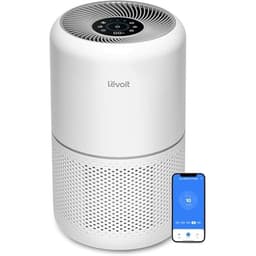
Levoit Core 300S Air Purifier
Best For
Continuous HEPA filtration of airborne mold spores in a bedroom or single room
Works In
Runs continuously; noticeable air quality readout changes within hours
Price
$149.99
$149.99 / count
Pros
- ✓True HEPA filtration rated for particles in the 0.3-micron range, well within the size of mold spores
- ✓Smart air quality sensor shows real-time particulate levels, useful for confirming a damp room is actually worse
- ✓Quiet enough to run continuously, which matters more than peak CADR for steady spore reduction
Cons
- ✗Only removes airborne spores — does nothing for mold growing on a damp surface
- ✗Sized for a single room, not a whole-home solution to a widespread moisture problem
- ✗Filter needs regular replacement to keep working at rated efficiency
We earn 1-4%/sale if you sign up · See all commissions
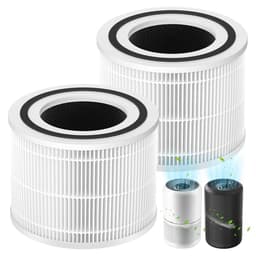
HEPA Replacement Filters (compatible multi-pack)
Best For
Keeping any HEPA purifier at its rated capture efficiency instead of quietly degrading
Works In
Replace roughly every 6-8 months, sooner in a heavily mold-affected space
Price
$23.98
$11.99 / count
Pros
- ✓A clogged filter is one of the most common reasons a purifier stops actually helping — this is the fix most people skip
- ✓Multi-packs make it cheap enough to replace on schedule instead of stretching one filter for a year
- ✓Compatible with common purifier models, so you're not locked into buying only branded replacements
Cons
- ✗Not a fix on its own — only useful paired with an actual purifier
- ✗Replacement frequency in a persistently damp room may be shorter than the standard interval
- ✗Doesn't address the moisture source; still just captures what's already airborne
We earn 1-4%/sale if you sign up · See all commissions
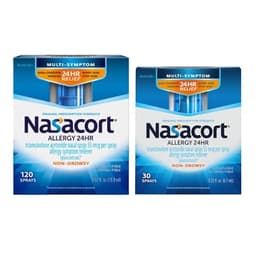
Nasacort Allergy 24HR (triamcinolone acetonide)
Best For
Ongoing nasal congestion, sneezing, and runny nose from mold and other perennial (year-round) allergens
Works In
Some relief within a day, full effect within about a week of daily use
Price
$28.99
$0.19 / count
Pros
- ✓Randomized, placebo-controlled trial evidence supports its use for perennial allergic rhinitis, the category mold allergy falls into
- ✓Intranasal corticosteroids outperform oral antihistamines for nasal symptoms in a systematic review of randomized trials
- ✓Once-daily, non-drowsy, available over the counter
Cons
- ✗Doesn't address itchy or watery eyes as directly as an antihistamine or eye drop would
- ✗Needs about a week of consistent daily use to reach full effect — not a same-day rescue option
- ✗Won't do anything about the mold itself; it treats the allergic response, not the source
We earn 1-4%/sale if you sign up · See all commissions
Amazon prices retrieved from the Amazon Product Advertising API on . Prices and availability are accurate as of that time and may change.
Medication That Helps
For the allergic symptoms themselves — not the mold problem causing them — the same hierarchy that applies to other perennial (year-round) allergens applies here:
Intranasal corticosteroids like triamcinolone (Nasacort) or fluticasone (Flonase) are generally the most effective single medication class for nasal congestion, sneezing, and runny nose. A randomized, double-blind, placebo-controlled trial of triamcinolone acetonide aqueous nasal spray in young children (ages 2 to 5) with perennial allergic rhinitis — the category mold allergy falls under, since mold exposure isn't seasonal the way pollen is — found modest and mixed efficacy over placebo (the primary within-group symptom endpoint fell short of statistical significance), alongside a favorable safety profile PMID: 19441606. A systematic review comparing intranasal corticosteroids against oral antihistamines found the nasal steroids produced better control of nasal symptoms PMID: 9848901 — why they're generally first-line for ongoing allergic rhinitis. For a head-to-head on nasal spray options, see our nasal spray comparison guide.
Oral antihistamines (cetirizine, loratadine, fexofenadine) help more with itching and sneezing than congestion, and are a reasonable add-on to a nasal steroid rather than a substitute for one.
Saline nasal irrigation is a low-risk, non-drug option some people use alongside medication to rinse allergens and mucus out of the nasal passages. If you're deciding between a pressurized device and a gravity-fed neti-pot-style rinse, our Navage vs. NeilMed comparison breaks down the differences.
None of these medications treat the mold problem itself — they manage the allergic response to it. If you're on a daily nasal steroid and still have symptoms tracking a specific damp room, that's a sign to revisit the humidity and remediation sections above rather than escalate medication further.
When to See a Doctor
Most mold-related allergy symptoms respond to a combination of moisture control and standard allergy medication. See a doctor or allergist if symptoms persist or worsen despite a nasal steroid and confirmed humidity control; your asthma has become harder to manage; you notice signs of infection like fever or facial pain and pressure that doesn't resolve; or you want formal testing to confirm mold sensitization. Visible, extensive mold growth plus ongoing unexplained symptoms in the household is a reason to prioritize both a medical evaluation and a professional home assessment.
Frequently Asked Questions
How can I tell if it's a mold allergy or just a cold? Duration and pattern are the biggest tells. Colds typically resolve in 7-10 days and often come with fever or body aches; mold allergy symptoms persist for weeks, don't cause fever, and tend to worsen in specific damp rooms and ease when you're away from home.
How do I know if mold is actually making me sick? Look for a location pattern — symptoms that flare in a specific room and ease elsewhere, especially if you can see or smell mold there. An allergist can confirm mold sensitization with a skin-prick or blood test, though no test proves mold is causing your day-to-day symptoms specifically.
What's the best humidity level to prevent mold? Keep indoor relative humidity below 60%, with 30-50% as the more protective target range for both mold and dust mites, per general indoor air quality guidance including the EPA's.
Can I clean mold myself, or do I need a professional? Small patches (under about 10 square feet) on hard, nonporous surfaces are usually fine to clean yourself. Call a professional for larger areas, porous materials like drywall or carpet, mold in your HVAC system, recurring mold, or ongoing household symptoms.
Do air purifiers actually help with mold allergy? A true HEPA purifier can capture airborne mold spores, but it only removes what's already airborne — it doesn't address mold growing on a damp surface, and a systematic review found the symptom-improvement evidence for indoor allergen reduction devices is inconsistent. It's a helpful adjunct, not a fix for the moisture problem.
What medication helps with mold allergy symptoms? Intranasal corticosteroids like triamcinolone (Nasacort) are generally the most effective single option and outperform oral antihistamines for nasal symptoms in trial data. Oral antihistamines still help with itching and sneezing and are often used alongside a nasal steroid.
References
- Fisk WJ, Eliseeva EA, Mendell MJ. Association of residential dampness and mold with respiratory tract infections and bronchitis: a meta-analysis. Environmental Health. 2010;9:72. PMID: 21078183.
- Sharpe RA, Bearman N, Thornton CR, Husk K, Osborne NJ. Indoor fungal diversity and asthma: a meta-analysis and systematic review of risk factors. Journal of Allergy and Clinical Immunology. 2015;135(1):110-122. PMID: 25159468.
- Sauni R, Verbeek JH, Uitti J, Jauhiainen M, Kreiss K, Sigsgaard T. Remediating buildings damaged by dampness and mould for preventing or reducing respiratory tract symptoms, infections and asthma. Cochrane Database of Systematic Reviews. 2015;2015(2):CD007897. PMID: 25715323.
- Manuyakorn W, Padungpak S, Luecha O, et al. Assessing the efficacy of a novel temperature and humidity control machine to minimize house dust mite allergen exposure and clinical symptoms in allergic rhinitis children sensitized to dust mites: a pilot study. Asian Pacific Journal of Allergy and Immunology. 2015;33(2):129-135. PMID: 26141034.
- Weinstein S, Qaqundah P, Georges G, et al. Efficacy and safety of triamcinolone acetonide aqueous nasal spray in children aged 2 to 5 years with perennial allergic rhinitis: a randomized, double-blind, placebo-controlled study with an open-label extension. Annals of Allergy, Asthma & Immunology. 2009;102(4):339-347. PMID: 19441606.
- Weiner JM, Abramson MJ, Puy RM. Intranasal corticosteroids versus oral H1 receptor antagonists in allergic rhinitis: systematic review of randomised controlled trials. BMJ. 1998;317(7173):1624-1629. PMID: 9848901.
- Matsui EC, Abramson SL, Sandel MT, et al. Effectiveness of indoor allergen reduction in asthma management: A systematic review. Journal of Allergy and Clinical Immunology. 2018;141(5):1854-1869. PMID: 29452202.