If you've ever loved a cat or dog while also sneezing, wheezing, or breaking out in hives around them, you know the central tension of pet allergies: the thing causing your symptoms is also, often, a member of your family. This guide covers what's actually happening in your immune system, why the "hypoallergenic dog" claim mostly doesn't hold up, what dander removal can and can't accomplish, and which medications and long-term treatments have real evidence behind them — rather than the fantasy of a single product that solves everything.
This article is for general education and isn't a substitute for advice from your own physician or allergist.
Quick Answer
No product fully removes cat or dog allergen while the pet stays, but airborne Fel d 1 and Can f 1 drop substantially with HEPA air cleaning, frequent vacuuming, and a strict bedroom-pet ban; layer that with a non-drowsy antihistamine like Zyrtec, azelastine (Astepro), and — for lasting relief — allergen immunotherapy.
Why Cats and Dogs Trigger Allergies
Pet allergy isn't a reaction to fur itself — it's a reaction to specific proteins. In cats, the major allergen is Fel d 1, produced mainly in sebaceous and salivary glands and spread through the coat during grooming. In dogs, it's Can f 1, produced primarily in skin and saliva. Both shed continuously as microscopic dander, go airborne easily, and settle onto furniture and clothing, where they get stirred back into the air long after the pet has left the room.
This is a genuinely common problem: sensitization to cat and dog allergens affects a meaningful share of the population, with European clinic-based estimates around 26-27% of adults evaluated for suspected inhalant allergy, per a consensus document from Spanish allergy specialists PMID: 29318625. Not everyone sensitized on a skin or blood test goes on to have clinical symptoms with exposure, but a large share do.
Fel d 1 and Can f 1 particles are small and lightweight compared with dust mite allergen, so they stay airborne longer and travel further through a house. They're also famously "sticky," clinging to walls and upholstery in a way that makes pet allergen one of the harder indoor allergens to fully clear out — even after the source pet is gone.
Can You Build Immunity to Cat Allergies?
This is one of the most common questions from people who already own a cat and are hoping their body will simply adapt. The honest answer: not reliably, and not through ordinary day-to-day exposure. There's no good clinical evidence that continuing to live with a cat trains an already-sensitized immune system into tolerance the way repeated mild sun exposure builds a tan. For some people, continued exposure to an allergen they're sensitized to makes symptoms worse over time, not better.
What can retrain the immune system in a durable way is allergen immunotherapy — allergy shots or under-the-tongue drops/tablets — which deliberately introduces small, gradually increasing doses of the specific allergen under medical supervision over months to years. That's a fundamentally different exposure pattern than casual contact with a pet, and it's the one route with real trial evidence behind the word "tolerance." More in the sublingual immunotherapy guide and later in this article.
One nuance: some population-level research suggests early-life exposure to pets may lower the odds of developing sensitization in the first place. That's a different phenomenon from an already-allergic adult tolerating an existing cat, and it isn't a reason to expect your current symptoms to fade with more exposure.
Are Hypoallergenic Dogs Really Hypoallergenic?
Short answer: mostly not, and it's one of the more persistent myths in this space. The idea took hold partly because certain breeds — poodles, Portuguese water dogs, Labradoodles, Spanish water dogs — shed less visible hair, and people reasonably (but incorrectly) assumed less shed hair meant less allergen.
The most direct test measured Can f 1 in hair samples and household dust from homes with breeds marketed as hypoallergenic versus homes with shedding breeds like Labrador retrievers. No breed classification reliably produced lower Can f 1 levels — if anything, some "hypoallergenic" breeds measured as high or higher than shedding controls, and airborne allergen levels didn't differ meaningfully by breed group either PMID: 22728082. The study's own title states the conclusion plainly: a lack of evidence to describe any dog breed as hypoallergenic.
What the same research does show is enormous individual variation — within a single breed, some dogs produce far more allergen than others, and intact males tend to produce more Can f 1 than females. Breed is a poor predictor of how much allergen a given dog sheds; the individual animal matters more than its breed label. The same logic applies to cats — no breed has rigorous evidence of meaningfully lower Fel d 1 output either, despite similar marketing around breeds like the Siberian.
Removing Pet Dander From Your House
Here's where candor matters most: no cleaning regimen, air purifier, or vacuum gets cat or dog allergen down to zero while the pet still lives in your home. The evidence supports meaningful reduction, not elimination — and the benefit doesn't always translate cleanly into symptom relief.
Air cleaning. A placebo-controlled trial of a HEPA air cleaner for cat allergy found it reduced airborne cat allergen in the room where it ran, but found no significant effect on any measure of disease activity — nasal or chest symptom scores, peak flow, sleep quality, and medication use were all statistically indistinguishable from the control group PMID: 9655716. That gap — a real, measurable drop in airborne allergen with no measurable symptom benefit in this controlled trial — is exactly why reducing exposure isn't the same as eliminating symptoms, and it shows up repeatedly in this research area. A broader systematic review of indoor allergen reduction strategies for asthma management found no single intervention reliably improved validated asthma control measures alone, though combining several together showed moderate-strength evidence for fewer exacerbations and better quality of life PMID: 29452202. Air purifiers are one piece of a layered approach, not a standalone fix.
Washing the pet. Bathing a cat measurably reduces allergen on its coat and in the air right afterward — one study found weekly washing produced significant drops in airborne Fel d 1 immediately post-bath — but the effect is short-lived, with levels climbing back within about a week PMID: 9314341. Washing helps most as a recurring habit, not a one-time fix.
Vacuuming and surfaces. A HEPA-filtered vacuum captures allergen-laden dust that a standard vacuum simply recirculates back into the air. Paired with washable slipcovers, minimal carpeting, and regular laundering, vacuuming reduces the reservoir of settled allergen available to go airborne again — though it won't remove allergen worked into upholstery fibers or walls, part of why Fel d 1 can persist in a home for weeks to months after these interventions begin.
Allergen reduction vs. symptom relief. A study directly tracking both cat allergen levels and patient symptoms found lower Fel d 1 exposure corresponded with improved nasal airflow and symptom scores PMID: 12952114 — but the benefit was modest, and other trials in this space have shown weaker or null symptom effects despite clear allergen reductions. Cleaning measures reliably lower allergen in your air and on your surfaces; whether that translates into symptom improvement you'll notice varies by person and by how aggressively you implement the changes.
The Bedroom-Exclusion Strategy
If you do one thing, make it this: keep the pet out of your bedroom, full-time, with the door closed. You spend roughly a third of your life there, much of it with your face close to bedding that efficiently traps dander. A bedroom that's stayed pet-free for a while, combined with a continuously running HEPA air cleaner and allergen-resistant mattress and pillow covers, is one of the more evidence-consistent ways to cut your total daily allergen dose without giving up the pet entirely.
A few notes that make this actually work rather than quietly eroding over weeks:
- Close the door consistently — even occasional access reintroduces meaningful allergen, since both Fel d 1 and Can f 1 travel easily on air currents and clothing.
- Wash bedding weekly in hot water; dander accumulates in fabric over time.
- Size the air cleaner to your bedroom's square footage — an undersized unit run quietly on low won't clear the air fast enough to matter.
- Consider swapping bedroom carpet for hard flooring if practical; carpet holds far more settled allergen than a comparable area of hardwood, and a vacuum only partially retrieves it.
This strategy works best as a floor, not a ceiling — pairing it with medication and, if warranted, immunotherapy gets you further than the bedroom rule alone.
Medication That Helps
Two drug classes cover most of what's useful for day-to-day symptom control, and they target different symptoms, which is why many people use both.
Oral antihistamines like cetirizine (Zyrtec) block histamine, the chemical behind much of the sneezing, itching, and runny nose in an allergic reaction. A randomized, placebo-controlled trial in patients with seasonal allergic rhinitis and concurrent asthma found cetirizine produced meaningful symptom improvement without worsening asthma control PMID: 7751511. It's non-drowsy for most people, once-daily, and a reasonable first-line option for itching and sneezing.
Intranasal antihistamines like azelastine (Astepro) act faster and more directly on congestion than an oral antihistamine typically does. A review of azelastine's clinical pharmacology found it acts within about 15 minutes and, in head-to-head studies, performed comparably to — and sometimes better than — oral antihistamines and at least one intranasal corticosteroid for allergic rhinitis symptom control PMID: 20477689. For pet-triggered congestion (say, before visiting a friend's cat), azelastine's rapid onset suits as-needed use in a way daily oral dosing isn't designed for.
Neither drug class treats the underlying cause — they manage symptoms during exposure. Many people combine a daily oral antihistamine as a baseline with an as-needed nasal spray for exposure spikes. For eye-specific itching that persists despite both, an antihistamine eye drop is worth adding; our full ranking of allergy medicines covers how the major OTC options compare.
Our Rankings
These four products cover the two main levers most people reach for first — allergen reduction and symptom control — ranked by the evidence behind their category and how they're best used for pet allergy.
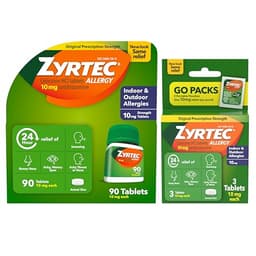
Zyrtec (cetirizine)
Best For
Daily baseline control of sneezing, itching, and runny nose from ongoing pet exposure
Works In
About 1 hour, non-drowsy for most people
Price
$43.89
$0.47 / count
Pros
- ✓Trial evidence in patients with concurrent asthma shows symptom benefit without worsening asthma control
- ✓Once-daily dosing fits a baseline, all-day management strategy
- ✓Widely available and inexpensive as a generic
Cons
- ✗Doesn't address nasal congestion as directly as an intranasal option
- ✗Some people still notice mild drowsiness even though it's classified as low-sedating
- ✗Doesn't reduce allergen exposure itself — symptom control only
We earn 1-4%/sale if you sign up · See all commissions
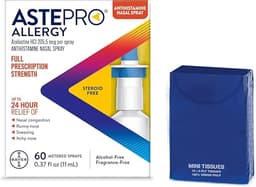
Astepro (azelastine nasal spray)
Best For
Fast, as-needed relief for congestion before or during pet exposure
Works In
About 15 minutes
Price
$17.48
$0.29 / count
Pros
- ✓Head-to-head trial evidence shows efficacy comparable to or better than oral antihistamines for nasal symptoms
- ✓Rapid onset makes it useful for planned exposure (visiting a home with pets) rather than only daily dosing
- ✓Available over the counter, no prescription needed
Cons
- ✗A bitter taste after spraying is a common complaint
- ✗Twice-daily dosing needed for continuous coverage, not just single-use
- ✗Doesn't address eye or skin symptoms
We earn 1-4%/sale if you sign up · See all commissions
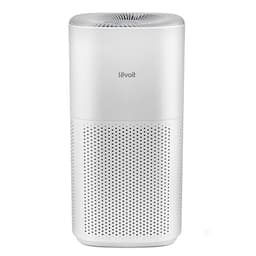
Levoit Core 600S HEPA Air Purifier
Best For
Reducing airborne pet dander in a bedroom or main living space
Works In
Continuous use; airborne allergen reduction is measurable but symptom benefit varies by person
Price
$259.99
~$230 one-time of use
Pros
- ✓True HEPA filtration is the mechanism shown to reduce airborne cat allergen in controlled trials
- ✓Large-room coverage suitable for a bedroom-exclusion strategy or an open living area
- ✓Quiet enough to run continuously, which matters since intermittent use limits benefit
Cons
- ✗Reduces airborne allergen, not allergen already settled on surfaces — needs to be paired with cleaning
- ✗A controlled trial of HEPA filtration for cat allergy found no significant symptom benefit despite a clear drop in airborne allergen
- ✗Replacement filters are an ongoing cost
We earn 1-4%/sale if you sign up · See all commissions
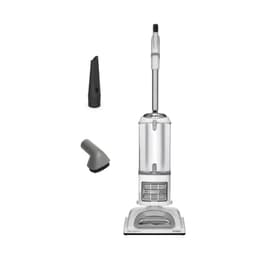
Shark HEPA Vacuum
Best For
Removing settled dander from carpet, upholstery, and pet bedding
Works In
Ongoing, with regular use (2+ times weekly in pet-heavy areas)
Price
$199.99
~$250 one-time of use
Pros
- ✓HEPA-sealed exhaust prevents recirculating captured allergen back into the air, unlike a standard vacuum
- ✓Effective on the settled-allergen side of the problem that air purifiers alone don't reach
- ✓Attachments useful for upholstery and pet bedding specifically
Cons
- ✗Won't remove allergen worked deep into carpet fibers or walls in one pass
- ✗Needs consistent, frequent use to keep pace with ongoing shedding
- ✗Bulkier and heavier than a standard stick vacuum
We earn 1-4%/sale if you sign up · See all commissions
Amazon prices retrieved from the Amazon Product Advertising API on . Prices and availability are accurate as of that time and may change.
For a broader comparison across every major air purifier on the market — not just the pick above — see our full air purifier rankings for allergies, which weighs CADR, room size, and filter cost across more options.
When Immunotherapy Makes Sense
If you've tried layered allergen reduction and medication and you're still symptomatic — or giving up the pet isn't an option you're willing to consider — allergen immunotherapy is the treatment category with the strongest claim to actually changing the underlying allergic response, rather than just managing symptoms around it.
Subcutaneous immunotherapy (allergy shots) for cat and dog allergens has real-world evidence behind it. A study following patients through an accelerated ("ultrarush") up-dosing protocol found meaningful improvement in rhinitis and asthma symptoms and quality-of-life scores as early as one month in, holding at the 6-month follow-up PMID: 33237025 — a real-world clinical study rather than a small proof-of-concept trial.
Sublingual immunotherapy — allergen drops or tablets under the tongue rather than injected — is a needle-free alternative some patients prefer, though the pet-specific evidence base for SLIT is smaller than for cat and dog SCIT. If you're weighing shots against drops, our sublingual immunotherapy guide covers that comparison directly.
Immunotherapy is a multi-month-to-multi-year commitment, not a quick fix, and it requires a formal allergy workup with a physician to confirm what you're sensitized to and manage the up-dosing safely. It's worth discussing with an allergist if your quality of life is meaningfully limited by ongoing pet exposure you don't want to eliminate.
Managing vs. Rehoming: A Candid Look
Some pet-allergic people manage well long-term with the combination above; others find that even a fully layered approach doesn't get symptoms to a tolerable level, especially if allergy also triggers asthma. If moderate-to-severe symptoms aren't well controlled despite consistent use of these measures, that's a conversation for an allergist rather than something to push through — uncontrolled allergic asthma carries real risk. There's no universally "right" answer between keeping a pet you love and prioritizing your respiratory health; the goal here is giving you the real evidence to make that call with clear eyes, not marketing promises about hypoallergenic breeds or products that eliminate allergen entirely.
Frequently Asked Questions
Can you build immunity to cat allergies? Not reliably through everyday exposure — continued contact doesn't consistently train tolerance, and symptoms can worsen instead. Immunotherapy, done under medical supervision, is the approach with real evidence for building durable tolerance.
Are hypoallergenic dogs really hypoallergenic? Largely a myth. Measured Can f 1 levels showed no reliable difference between breeds marketed as hypoallergenic and standard shedding breeds — individual dogs vary far more than breeds do.
How do I remove pet dander from my house? HEPA air cleaning, HEPA vacuuming, and weekly pet washing all measurably reduce allergen, but none get it to zero while the pet stays, and symptom improvement doesn't always track cleanly with allergen reduction.
Should I keep my pet out of the bedroom if I'm allergic? Yes — one of the higher-yield single changes, especially combined with a HEPA air cleaner and allergen-resistant bedding covers in that room.
What medication helps with pet allergies? A non-drowsy oral antihistamine like cetirizine (Zyrtec) for daily baseline control, plus an intranasal antihistamine like azelastine (Astepro) for fast relief of congestion.
When does immunotherapy make sense for pet allergies? When allergen control and medication aren't enough, or you're not willing to give up living with pets — allergy shots have real-world evidence for symptom improvement persisting at 6 months, and sublingual options exist as a needle-free alternative.
References
- Dávila I, Domínguez-Ortega J, Navarro-Pulido A, et al. Consensus document on dog and cat allergy. Allergy. 2018;73(6):1206-1222. PMID: 29318625.
- Vredegoor DW, Willemse T, Chapman MD, Heederik DJ, Krop EJ. Can f 1 levels in hair and homes of different dog breeds: lack of evidence to describe any dog breed as hypoallergenic. Journal of Allergy and Clinical Immunology. 2012;130(4):904-909.e7. PMID: 22728082.
- Avner DB, Perzanowski MS, Platts-Mills TA, Woodfolk JA. Evaluation of different techniques for washing cats: quantitation of allergen removed from the cat and the effect on airborne Fel d 1. Journal of Allergy and Clinical Immunology. 1997;100(3):307-312. PMID: 9314341.
- Wood RA, Johnson EF, Van Natta ML, Chen PH, Eggleston PA. A placebo-controlled trial of a HEPA air cleaner in the treatment of cat allergy. American Journal of Respiratory and Critical Care Medicine. 1998;158(1):115-120. PMID: 9655716.
- Leas BF, D'Anci KE, Apter AJ, et al. Effectiveness of indoor allergen reduction in asthma management: A systematic review. Journal of Allergy and Clinical Immunology. 2018;141(5):1854-1869. PMID: 29452202.
- Björnsdottir US, Jakobinudottir S, Runarsdottir V, Juliusson S. The effect of reducing levels of cat allergen (Fel d 1) on clinical symptoms in patients with cat allergy. Annals of Allergy, Asthma & Immunology. 2003;91(2):189-194. PMID: 12952114.
- Grant JA, Nicodemus CF, Findlay SR, et al. Cetirizine in patients with seasonal rhinitis and concomitant asthma: prospective, randomized, placebo-controlled trial. Journal of Allergy and Clinical Immunology. 1995;95(5 Pt 1):923-932. PMID: 7751511.
- Horak F, Zieglmayer UP. Azelastine nasal spray for the treatment of allergic and nonallergic rhinitis. Expert Review of Clinical Immunology. 2009;5(6):659-669. PMID: 20477689.
- Uriarte SA, Grönlund H, Wintersand A, Bronge J, Sastre J. Clinical and Immunologic Changes due to Subcutaneous Immunotherapy With Cat and Dog Extracts Using an Ultrarush Up-Dosing Phase: A Real-Life Study. Journal of Investigational Allergology and Clinical Immunology. 2022;32(2):133-140. PMID: 33237025.