Itchy, watery, allergy-swollen eyes send people to the drugstore aisle constantly, and it's a genuinely confusing one — antihistamine drops, "redness relief" drops, decongestant drops, and artificial tears all sit next to each other making similar-sounding promises. Only some of them actually treat the allergic reaction; one popular category can quietly make things worse the longer you use it. This guide ranks the over-the-counter eye drops with real randomized-trial evidence behind them for allergic itching, and is candid about which ones to leave on the shelf.
This article is for general education and isn't a substitute for advice from your own physician, pharmacist, or ophthalmologist.
Quick Answer
Olopatadine (Pataday) and ketotifen (Zaditor) are both dual-action antihistamine/mast-cell-stabilizer drops with solid randomized-trial evidence for itchy, watery allergy eyes. Olopatadine is dosed once daily and edges out ketotifen on itch relief in head-to-head trials; ketotifen needs twice-daily dosing. Skip redness-relief drops like Visine — they don't treat the allergy and can cause rebound redness.
How Allergy Eye Drops Actually Work
Allergic conjunctivitis — the redness, itching, watering, and swelling triggered by pollen, dust mites, or pet dander landing directly on the eye surface — affects a substantial share of people with seasonal or year-round allergies, with prevalence estimates in some populations reaching as high as 40% PMID: 21785348. The reaction runs through mast cells in the conjunctiva, which release histamine and other inflammatory mediators when they encounter an allergen, producing the itch-redness-tearing cycle almost immediately.
That mechanism is why the two best-performing OTC options — olopatadine (the active ingredient in Pataday) and ketotifen (the active ingredient in Zaditor) — work the way they do. Both are "dual-action" drops: they block the H1 histamine receptor to stop the itch signal already in progress, and they stabilize mast cells to reduce how much histamine gets released on the next exposure PMID: 30020258. A Cochrane systematic review of topical antihistamines and mast-cell stabilizers for allergic conjunctivitis found this drug class consistently reduced itching and other symptoms compared with placebo across the trials it pooled, though it also noted that most individual trials were short and not designed to compare agents against each other head-to-head PMID: 26028608 — which is exactly why the direct Pataday-vs-Zaditor comparisons below matter.
Our Rankings
These rankings weigh randomized-trial evidence for itch and redness relief in allergic conjunctivitis, not price or shelf placement. Store-brand ketotifen (often sold as "Alaway" or generic "ketotifen fumarate ophthalmic solution 0.025%") is evidence-equivalent to Zaditor.
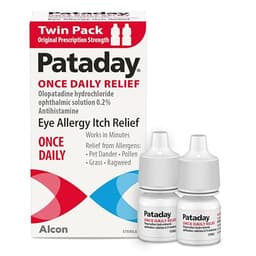
Pataday (olopatadine hydrochloride)
Best For
Once-daily dosing with the fastest, best-documented itch relief of any OTC allergy eye drop
Works In
Minutes for itch; full effect within about an hour
Price
$24.75
$12.38 / count
Pros
- ✓A placebo-controlled RCT found olopatadine 0.1% significantly reduced ocular itching and hyperemia across a 10-week grass-pollen season
- ✓The newer once-daily 0.7% formulation (Pataday Once Daily Relief) showed significant symptom reduction in a Phase 3 conjunctival allergen challenge trial
- ✓Approved for extended, season-long use rather than short-term-only labeling
Cons
- ✗Costs more per bottle than generic ketotifen
- ✗Once-daily dosing still means missing the morning dose can leave you uncovered by evening
- ✗Some formulations sting briefly on instillation, similar to most ophthalmic antihistamines
We earn 1-4%/sale if you sign up · See all commissions
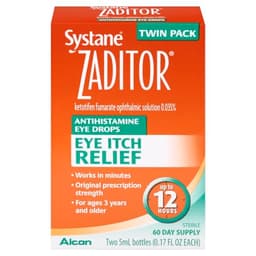
Zaditor (ketotifen fumarate 0.025%)
Best For
Budget-friendly dual-action relief for people who don't mind twice-daily dosing
Works In
As fast as 15 minutes, lasting up to 8 hours per dose
Price
$10-14/mo
Pros
- ✓A placebo-controlled conjunctival allergen challenge trial found ketotifen significantly reduced itching and redness at every time point tested, with onset within 15 minutes
- ✓A 519-subject multicenter trial found ketotifen's responder rate was significantly higher than placebo
- ✓Widely available as an inexpensive store-brand generic (ketotifen fumarate 0.025%)
Cons
- ✗Needs dosing roughly every 8-12 hours, versus once daily for olopatadine
- ✗A head-to-head trial found olopatadine produced faster and somewhat greater itch and redness relief than ketotifen; a meta-analysis confirmed the redness advantage but found no significant itch difference
- ✗Some OTC ketotifen labeling is more conservative about extended use than olopatadine's
We earn 1-4%/sale if you sign up · See all commissions
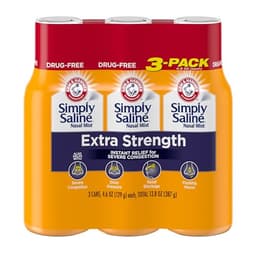
Preservative-Free Artificial Tears / Saline Eye Rinse
Best For
A soothing adjunct alongside an antihistamine drop, not a standalone allergy treatment
Works In
Immediately, but only for mechanical rinsing and comfort
Price
$19.56
$1.42 / ounce
Pros
- ✓Physically flushes allergens (pollen, dander) off the eye surface, which no antihistamine drop does on its own
- ✓Preservative-free single-use vials are gentle enough for frequent use without the buildup concerns of preserved formulas
- ✓Safe to use as often as needed alongside olopatadine or ketotifen, with no interaction
Cons
- ✗Does not block histamine or stabilize mast cells — it dilutes and rinses, it doesn't treat the allergic reaction itself
- ✗Effect is short-lived compared with a dual-action drop's multi-hour coverage
- ✗Not a substitute for an antihistamine drop if itching is the dominant symptom
We earn 1-4%/sale if you sign up · See all commissions
Amazon prices retrieved from the Amazon Product Advertising API on . Prices and availability are accurate as of that time and may change.
Pataday vs. Zaditor: What's the Real Difference?
This is the single most-searched comparison in this category, and the honest answer is that both drops work — the differences are mostly about dosing convenience and a modest efficacy edge, not one drug being clearly superior. Both olopatadine and ketotifen are dual-action antihistamine/mast-cell stabilizers, both have placebo-controlled randomized trials supporting them individually PMID: 12852709 PMID: 12742839, and both have been tested directly against each other more than once.
A randomized trial comparing the two head-to-head in 120 patients with allergic conjunctivitis found olopatadine reduced itching, tearing, hyperemia, and total symptom score faster than ketotifen — a significant difference had emerged by day four — and reported fewer adverse reactions with olopatadine (10% vs. 18%) PMID: 29719638. A separate meta-analysis pooling six to seven randomized trials found a narrower but consistent pattern on redness specifically: olopatadine was associated with significantly lower hyperemia scores than ketotifen at multiple follow-up points, though the two drugs showed no significant difference in itching, tearing, or papillae scores across the pooled trials PMID: 37312902.
That's a real advantage for olopatadine — a redness edge confirmed in both the head-to-head trial and the pooled meta-analysis, plus a faster, somewhat greater itch-relief edge documented in the single head-to-head RCT — but it's a modest one, not a blowout, and it comes bundled with practical differences that matter more for some people than a few points on a symptom scale. Olopatadine's once-daily dosing (twice-daily for the older 0.1% formulation, once-daily for the 0.2% and 0.7% versions) is easier to stick with than ketotifen's up-to-twice-daily schedule, especially for anyone who already struggles to remember one drop a day. Ketotifen, in exchange, is usually the cheaper option and has been available over the counter for longer, so store-brand versions (often labeled "Alaway" or generic ketotifen fumarate 0.025%) are easy to find at a lower price than brand-name Pataday. If itch relief is the deciding factor and cost isn't a constraint, olopatadine is the reasonable first choice; if budget matters more and twice-daily dosing isn't a burden, ketotifen is a legitimately effective alternative, not a downgrade.
Why Do My Eyes Itch So Much at Night?
Nighttime allergy-eye itching has a straightforward explanation most people don't connect: your face spends seven or eight hours pressed against the exact surfaces where allergens concentrate. Pillows and pillowcases accumulate dust mite allergen and shed skin cells over time, pet dander settles onto bedding if a cat or dog has access to the bedroom, and pollen carried in on hair and clothing during the day gets transferred directly onto the pillow at night. Combined with a naturally slower tear-film turnover during sleep — there's less blinking to mechanically clear the eye surface — allergens that would otherwise get rinsed away during the day are left sitting against the eye for hours.
Two practical fixes address this directly. First, treat the bedroom environment: washing pillowcases weekly in hot water, keeping pets out of the bedroom if pet dander is a suspected trigger, and showering before bed to rinse pollen out of hair all reduce the allergen load your eyes are exposed to overnight. Our dust mite allergy guide and pet allergy guide go deeper on bedroom-specific allergen control if either is a likely culprit. Second, timing matters for the drops themselves — since both olopatadine and ketotifen take effect within about an hour and provide multi-hour coverage, using your evening dose shortly before bed rather than earlier in the day means peak drug levels line up with the hours you're most exposed, instead of wearing off partway through the night.
Eye Drops to Avoid: Visine and the Rebound Redness Trap
Not every drop in the eye-care aisle treats allergies, and one popular category can actively work against you with regular use. Original Visine and similar "get the red out" products contain a vasoconstrictor — tetrahydrozoline or naphazoline — that works by shrinking the blood vessels in the eye's surface, which makes redness disappear cosmetically without doing anything to the underlying allergic reaction. That distinction matters, because the itching, swelling, and allergen exposure driving your symptoms are all still there; only the visible redness is masked.
The bigger problem is what happens with repeated use. A modern pharmacology review of OTC ocular decongestants notes that these vasoconstrictors are associated with tachyphylaxis (the drug losing effectiveness with continued use) and rebound redness once the drop wears off or is discontinued — eyes that look redder than they did before starting the drop PMID: 32801982. This pattern has a name in the ophthalmology literature, conjunctivitis medicamentosa, describing chronic redness and irritation caused by the decongestant drop itself rather than by the original allergy PMID: 8027493. It's worth noting the phenomenon appears to depend on dose and duration of use — a smaller, older study of healthy volunteers using a decongestant for 10 days found reduced whitening effectiveness (tachyphylaxis) but didn't demonstrate overt rebound vasodilation in that specific short window PMID: 6514304 — which is consistent with the general clinical guidance that occasional, short-term use of a decongestant drop is a different risk profile than daily, ongoing use.
The practical takeaway: a decongestant-only drop is reasonable for the occasional isolated redness (irritation from smoke, chlorine, a late night), used sparingly and briefly. It is not a treatment for allergic conjunctivitis, and using it as your daily allergy drop risks trading a manageable itch problem for a harder-to-shake redness problem. If allergy symptoms are recurring or seasonal, reach for olopatadine or ketotifen instead — they address the actual mechanism and don't carry the same rebound risk.
When to See a Doctor Instead of Self-Treating
Most allergic-conjunctivitis symptoms respond well to an OTC dual-action drop within a few days. It's worth escalating beyond self-treatment if: eye pain (rather than itch), light sensitivity, or vision changes accompany the redness, since these can signal something other than simple allergy; symptoms don't improve after a consistent one-to-two-week trial of olopatadine or ketotifen used as directed; you wear contact lenses and are having a flare, since lens wear changes both the risk profile and the treatment approach; or you find yourself reaching for a decongestant drop most days just to look less red, which is itself a sign to see an eye doctor rather than keep escalating on your own. An ophthalmologist or allergist can also confirm the diagnosis, since some conditions that look like allergic conjunctivitis — dry eye, viral or bacterial conjunctivitis, blepharitis — need a different treatment entirely.
How to Choose
If you want the simplest, most evidence-backed daily routine and cost isn't the deciding factor, start with once-daily olopatadine (Pataday) — it has the strongest head-to-head itch-relief data and the easiest dosing schedule to actually stick with. If budget is the priority, generic ketotifen (store-brand Zaditor/Alaway equivalents) is a legitimately effective alternative that just asks a little more of your memory for a second daily dose. Either pairs well with preservative-free artificial tears for extra rinsing and comfort during high-pollen days, and neither should be combined with a decongestant drop as your regular allergy routine. For the bigger picture — oral antihistamines, nasal sprays, and when eye symptoms are part of a wider seasonal-allergy pattern — see our seasonal allergies survival guide and our ranking of the best allergy medicines. If oral antihistamines are also part of your routine, our Zyrtec vs. Claritin vs. Allegra comparison covers how to pick one that won't leave you drowsy during the day.
Frequently Asked Questions
What are the best eye drops for itchy eyes from allergies? Dual-action drops that combine an antihistamine with a mast-cell stabilizer — olopatadine (Pataday) and ketotifen (Zaditor) — have the strongest randomized-trial evidence for allergic itching, both against placebo and head-to-head against each other.
Pataday vs. Zaditor: which is better? Both are effective, evidence-backed options, and neither has a decisive efficacy edge. Olopatadine (Pataday) is once daily and showed somewhat faster, stronger itch relief in a head-to-head trial, plus a redness advantage confirmed by a meta-analysis; ketotifen (Zaditor) costs less but needs up to twice-daily dosing.
Why do my eyes itch so much at night? Allergens like dust mites, pet dander, and pollen concentrate on pillows and bedding, and slower overnight tear turnover lets them sit against the eye surface longer than during the day.
Is it bad to use Visine every day for allergies? Yes, for redness-relief products containing a vasoconstrictor (tetrahydrozoline or naphazoline). They mask redness without treating the allergic reaction, and regular use is linked to tolerance and rebound redness once the drop wears off.
Can I use allergy eye drops and allergy pills together? Yes — topical drops and an oral second-generation antihistamine target the same allergic pathway through different routes and are commonly combined when eye symptoms persist on pills alone.
How long can I use ketotifen or olopatadine eye drops? Olopatadine is commonly used for extended, season-long use. Ketotifen's OTC labeling is more conservative about extended use even though clinical trials have tested it over multiple weeks — check your specific product's label.
References
- Rosario N, Bielory L. Epidemiology of allergic conjunctivitis. Current Opinion in Allergy and Clinical Immunology. 2011;11(5):471-476. PMID: 21785348.
- Ben-Eli H, Solomon A. Topical antihistamines, mast cell stabilizers, and dual-action agents in ocular allergy: current trends. Current Opinion in Allergy and Clinical Immunology. 2018;18(5):411-416. PMID: 30020258.
- Castillo M, Scott NW, Mustafa MZ, et al. Topical antihistamines and mast cell stabilisers for treating seasonal and perennial allergic conjunctivitis. Cochrane Database of Systematic Reviews. 2015;2015(6):CD009566. PMID: 26028608.
- Abelson MB, Turner D. A randomized, double-blind, parallel-group comparison of olopatadine 0.1% ophthalmic solution versus placebo for controlling the signs and symptoms of seasonal allergic conjunctivitis and rhinoconjunctivitis. Clinical Therapeutics. 2003;25(3):931-947. PMID: 12852709.
- McLaurin E, Narvekar A, Gomes P, et al. Phase 3 Randomized Double-Masked Study of Efficacy and Safety of Once-Daily 0.77% Olopatadine Hydrochloride Ophthalmic Solution in Subjects With Allergic Conjunctivitis Using the Conjunctival Allergen Challenge Model. Cornea. 2015;34(10):1245-1251. PMID: 26266427.
- Abelson MB, Chapin MJ, Kapik BM, et al. Efficacy of ketotifen fumarate 0.025% ophthalmic solution compared with placebo in the conjunctival allergen challenge model. Archives of Ophthalmology. 2003;121(5):626-630. PMID: 12742839.
- Kidd M, McKenzie SH, Steven I, et al. Efficacy and safety of ketotifen eye drops in the treatment of seasonal allergic conjunctivitis. British Journal of Ophthalmology. 2003;87(10):1206-1211. PMID: 14507747.
- Patel D, Sarala N, Datti NP. Topical Olopatadine Hydrochloride versus Ketotifen Fumarate for Allergic Conjunctivitis. Journal of Ophthalmic and Vision Research. 2018;13(2):119-123. PMID: 29719638.
- Li S, Zhong S. Comparison of olopatadine with ketotifen for allergic conjunctivitis: a meta-analysis study. Postępy Dermatologii i Alergologii. 2023;40(2):326-330. PMID: 37312902.
- Hosten LO, Snyder C. Over-the-Counter Ocular Decongestants in the United States - Mechanisms of Action and Clinical Utility for Management of Ocular Redness. Clinical Optometry. 2020;12:95-105. PMID: 32801982.
- Spector SL, Raizman MB. Conjunctivitis medicamentosa. Journal of Allergy and Clinical Immunology. 1994;94(1):134-136. PMID: 8027493.
- Abelson MB, Butrus SI, Weston JH, Rosner B. Tolerance and absence of rebound vasodilation following topical ocular decongestant usage. Ophthalmology. 1984;91(11):1364-1367. PMID: 6514304.