Dust mite bedding covers are one of the most heavily marketed allergy products on the market, and also one of the most misunderstood. The packaging often implies a cover alone will calm your allergies — and the honest evidence doesn't fully back that up. What the research actually supports is narrower and more useful: a well-made encasement reliably blocks allergen from escaping a mattress or pillow, but clinical trials testing encasements by themselves have repeatedly found no significant improvement in asthma or allergic rhinitis symptoms. This guide opens with that evidence, then ranks covers on the construction details that determine whether the barrier actually works — pore size, zipper design, membrane versus microfiber, and breathability — instead of on symptom-cure claims the trials don't support.
This article is for general education and isn't a substitute for advice from your own physician or allergist.
Quick Answer
Dust mite mattress covers reliably block allergen inside a mattress, but trials on encasements used alone found no significant symptom improvement — benefit shows up when covers are paired with hot washing, HEPA vacuuming, and humidity control. Look for a six-sided, zippered cover with a pore size under 10 microns — the threshold lab testing shows blocks dust mite allergen.
Do Dust Mite Covers Really Work? The Honest Answer
Start with the two things that are true at the same time, because most marketing collapses them into one.
What's well established: a tightly woven or membrane-based cover physically blocks dust mite allergen from moving between the mattress interior and the room air. That's a materials-science claim, and it's been tested directly (more on the pore-size data below).
What's genuinely mixed: whether that barrier, used on its own, produces a measurable drop in symptoms. The most-cited evidence here is a large randomized controlled trial that fitted more than 1,100 adults with asthma with allergen-impermeable mattress, pillow, and quilt covers versus ordinary control covers. Mattress allergen levels dropped significantly in the intervention group by six months — but asthma symptoms, peak flow, and medication use showed no measurable difference between groups PMID: 12867606. A Cochrane systematic review pooling multiple trials of dust mite control measures, encasements chief among them, reached a similarly unenthusiastic conclusion: as a category, these measures couldn't be recommended as effective standalone symptom-relief interventions based on the pooled trial evidence PMID: 18425868.
That's a real, replicated finding — worth knowing before you spend $60-150 expecting a cover to fix your allergies on its own. The likely explanation isn't that covers fail at their one job; it's that mattress allergen is only one of several exposure sources in a bedroom, alongside carpet, upholstery, and settled dust elsewhere in the room. A joint practice parameter from U.S. allergy specialty societies is explicit that a multifaceted, sustained approach — encasements plus hot laundering, HEPA vacuuming, and humidity control together — outperforms any single measure used alone PMID: 24267359.
So we're not ranking on promised symptom relief. We're ranking on the construction quality that determines whether a cover does its one well-proven job — sealing allergen inside — efficiently and durably: pore size, zipper design, membrane versus microfiber build, and breathability. Our dust mite allergy guide walks through the full bundle these covers fit into, including washing temperature, vacuuming, and medication.
What Actually Blocks Allergen: Pore Size, Membrane vs. Microfiber
The single spec that matters most on a cover label — and the one most buying guides bury under marketing language — is pore size.
A laboratory study in the Journal of Allergy and Clinical Immunology pulled allergen-laden dust across a range of bedding-encasement fabrics, simulating the mechanical pressure a body puts on a mattress overnight. Fabrics with an average pore size under 10 microns blocked dust mite allergen (Der p 1 and Der f 1) below detectable limits, even at airflow up to 20 liters per minute; looser weaves let allergen straight through PMID: 9949312. That threshold isn't arbitrary — mite fecal particles, the actual allergen-carrying units, average roughly 10-40 microns across, so a pore size meaningfully smaller than that is what physically stops them.
Two fabric approaches solve this differently. Tightly woven microfiber hits a small enough pore size through thread count and weave density alone, no separate barrier layer — softer, quieter, and generally more breathable, but pore size varies more between manufacturers, so a verified lab number matters more than a marketing claim. Membrane-laminated fabric bonds a thin polyurethane-style barrier layer to a fabric face, typically landing at a smaller and more consistent pore size (some brands advertise around 6 microns, comfortably under the 10-micron threshold) — at some cost to breathability, and the membrane is the layer most likely to degrade under high-heat washing or drying.
Neither approach is universally better — a well-made version of either lands under the 10-micron bar. What separates a genuinely protective cover from a marketing-only one is whether the manufacturer publishes an independently verified pore-size or allergen-blocking number at all. A listing that only says "hypoallergenic" with no figure or lab reference is a yellow flag, not a spec.
Zippered (Six-Sided) vs. Fitted Covers — Which You Actually Need
The second decision point, after fabric and pore size, is coverage design, and it matters almost as much.
A six-sided, fully zippered encasement wraps the entire mattress — top, sides, and bottom — and seals with a zipper that closes the last seam completely. This is the only design that actually isolates the mattress interior, including the space where mites and years of accumulated allergen live in an older mattress. If dust mite allergy specifically (not just spill protection) is the goal, this is the design worth paying for.
A fitted, top-only protector covers the sleeping surface and tucks around the sides like a fitted sheet, but leaves the underside of the mattress open. That's a reasonable choice if you're mainly protecting a mattress warranty from spills, but it's a materially weaker allergy intervention — allergen and mites in the mattress core aren't sealed off, they're just under a top layer that doesn't fully isolate them.
A few zipper-specific details worth checking before you buy:
- A locking zipper pull or a fabric flap covering the zipper track. Cheaper covers use a plain zipper that can work loose over months of getting in and out of bed; a locking pull or covered track holds up better.
- Zipper placement that doesn't sit directly under your body. Some budget encasements put the zipper along a top seam where it's uncomfortable to lie on; better designs route it along a side or bottom edge.
- Reinforced stitching at the zipper corners, which is where cheaper encasements tend to fail first after repeated hot washes.
Our Rankings
These rankings weigh pore size, zipper and seam construction, and breathability — the specs that determine whether a cover actually does the one job the trial evidence supports (sealing allergen in), not promised symptom relief. We've also included a daily antihistamine as an adjunct, since covers work as part of a bundle rather than a substitute for treating the reaction that's already there.
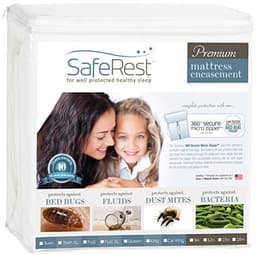
Mattress Encasement (Allergen-Proof, Six-Sided)
Best For
Sealing the largest allergen reservoir in the bedroom — the mattress interior
Works In
Ongoing use once installed; part of a bundled routine, not a standalone fix
Price
$59.00
~$40-70 one-time of use
Pros
- ✓Six-sided, fully zippered design isolates the mattress interior rather than just the top surface
- ✓Membrane or tight-weave construction rated under the 10-micron pore-size threshold that lab testing shows blocks Der p 1/Der f 1
- ✓One-time purchase that keeps working as long as the zipper and seams hold up
Cons
- ✗Randomized trial evidence shows encasements alone don't reliably improve symptoms without hot washing, vacuuming, and humidity control added
- ✗Must be genuinely six-sided — some budget listings market a top-only fitted protector using the same allergy language
- ✗Membrane-laminated versions can feel less breathable than a tightly woven microfiber alternative
We earn 1-4%/sale if you sign up · See all commissions
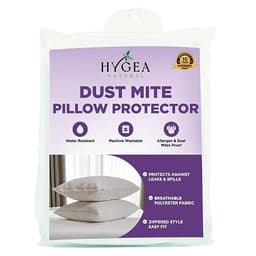
Dust Mite Pillow Covers
Best For
Protecting the surface closest to your face for 6-9 hours a night
Works In
Ongoing use; pairs with a mattress encasement rather than replacing it
Price
$13.99
$7.00 / count
Pros
- ✓Covers a high-exposure surface that's easy to skip if you only encase the mattress
- ✓Same pore-size logic applies at a much lower price point per item
- ✓Zips fully around the pillow rather than just slipping over one end
Cons
- ✗Same caveat as mattress encasements — evidence supports it as part of a routine, not a standalone symptom fix
- ✗Fabric and zipper quality vary more at this price point, so check for a published pore-size or allergen-block spec before buying
- ✗Needs periodic replacement (roughly every 1-2 years) as the fabric and zipper wear from frequent washing
We earn 1-4%/sale if you sign up · See all commissions
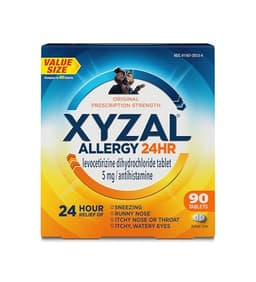
Xyzal (Levocetirizine) — Adjunct, Not a Cover Substitute
Best For
Treating the immune reaction that covers and cleaning can't fully eliminate
Works In
Within hours; taken nightly for consistent control
Price
$30.48
$0.34 / count
Pros
- ✓Randomized trial evidence in children with perennial allergic rhinitis (a pediatric trial, ages 6-12), the year-round pattern typical of dust mite allergy [PMID: 16136768](/cite/16136768)
- ✓Once-daily dosing at night lines up with when dust-mite-driven nasal symptoms tend to be worst
- ✓Addresses residual symptoms even after covers and laundering have reduced exposure as far as they realistically can
Cons
- ✗Doesn't replace environmental control — it's the other half of a bundle, not an alternative to a properly sealed mattress
- ✗Some users still notice next-day drowsiness despite a lower sedation profile than first-generation antihistamines
- ✗Doesn't address nasal congestion as directly as an intranasal corticosteroid for people whose main complaint is congestion
We earn 1-4%/sale if you sign up · See all commissions
Amazon prices retrieved from the Amazon Product Advertising API on . Prices and availability are accurate as of that time and may change.
Care and Washing: Keeping the Barrier Effective
A cover's protection isn't permanent once installed — it depends on the fabric staying intact and genuinely clean, which means washing it correctly rather than treating it as set-and-forget.
Wash temperature matters more than most labels admit. A frequently cited laundering study found that water at 130°F (54.4°C) or hotter reliably kills dust mites and washes their allergen out of fabric, while a warm wash around 104°F (40°C) left the large majority of mites alive PMID: 1401643. The complication for covers specifically: some membrane-laminated encasements cap their wash temperature below that threshold to protect the barrier layer from heat damage. Follow the manufacturer's label — if it caps out lower, lean on the encasement's physical barrier (which doesn't need heat to keep working) plus hot-washing the sheets and pillowcases that sit directly against it.
A realistic cadence: wash the encasement itself every 1-2 months; sheets and pillowcases still get a weekly hot wash regardless. Skip fabric softener and dryer sheets — residue can coat and clog the small pores that make the barrier work — and tumble dry membrane covers on low rather than high heat.
Replace, don't wash indefinitely. Zippers and seams wear with repeated laundering; most encasements hold up for 1-3 years before the barrier or hardware degrades. A cover with a failing zipper has effectively reverted to an ordinary fitted sheet.
Who a Cover Is (and Isn't) a Good Fit For
A dust mite cover is a reasonable, low-risk piece of an allergy-control plan if you: have a confirmed or suspected dust mite allergy with nighttime-clustered symptoms; are building a full routine that also includes hot laundering, HEPA vacuuming, and humidity control rather than expecting the cover alone to carry the whole job; or have an older mattress (5+ years) that's never been protected and likely carries a substantial accumulated allergen load.
It's a weaker standalone purchase if you're expecting it to meaningfully resolve symptoms on its own — the trial evidence above is fairly consistent that it won't. If your exposure is significantly airborne rather than concentrated in the mattress (pet dander drifting through the house, for instance), a cover won't touch that share of the problem; our guide to the best air purifiers for allergies covers the airborne-allergen piece a mattress cover can't reach. And if you've already built the full environmental bundle — covers, hot washing, vacuuming, humidity control, plus a daily antihistamine — and symptoms are still disruptive, sublingual immunotherapy for house dust mite is the next step with meta-analysis-level evidence behind it, since it targets the underlying sensitization rather than just the exposure PMID: 28293928.
Frequently Asked Questions
Do dust mite covers really work? They reliably cut measurable allergen inside the mattress — that's well established. But randomized trial evidence shows encasements used alone often don't produce a clear symptom improvement PMID: 12867606 PMID: 18425868; they work best as one part of a bundled routine that also includes hot washing, vacuuming, and humidity control.
What's the best allergen mattress protector to buy? A six-sided, fully zippered encasement made from a membrane or tightly woven fabric with a published, independently tested pore size under 10 microns — the threshold shown to block dust mite allergen.
Zippered vs fitted allergy covers — which do I actually need? A zippered, six-sided encasement, if allergy control is the goal — it's the only design that seals the mattress underside, where allergen and mites in the core otherwise stay exposed. A fitted top-only protector is fine for spills but is a materially weaker allergy intervention.
What pore size actually blocks dust mite allergen? Lab testing found fabrics with an average pore size under 10 microns block dust mite allergen (Der p 1/Der f 1) below detectable limits PMID: 9949312, since mite fecal particles run roughly 10-40 microns across. (The same study found an even tighter ~6-micron threshold was needed to block the smaller cat allergen, Fel d 1 — that figure isn't the dust-mite-relevant number.)
How do I wash and care for a dust mite cover without ruining it? Wash the cover every 1-2 months in water at least 130°F if the manufacturer's label allows it, since that's the temperature shown to reliably kill mites and rinse out allergen PMID: 1401643 — but follow the label's maximum temperature to avoid degrading a membrane layer, and skip fabric softener, which can clog the pores.
Do I need a pillow cover if I already have a mattress encasement? Yes. A pillow sits inches from your face for 6-9 hours a night and accumulates allergen just like a mattress does; pairing a pillow cover with a mattress encasement is standard practice in every well-supported dust-mite-avoidance protocol PMID: 24267359.
References
- Vaughan JW, McLaughlin TE, Perzanowski MS, Platts-Mills TA. Evaluation of materials used for bedding encasement: effect of pore size in blocking cat and dust mite allergen. Journal of Allergy and Clinical Immunology. 1999;103(2 Pt 1):227-231. PMID: 9949312.
- Woodcock A, Forster L, Matthews E, et al. Control of exposure to mite allergen and allergen-impermeable bed covers for adults with asthma. New England Journal of Medicine. 2003;349(3):225-236. PMID: 12867606.
- Gøtzsche PC, Johansen HK. House dust mite control measures for asthma. Cochrane Database of Systematic Reviews. 2008;(2):CD001187. PMID: 18425868.
- McDonald LG, Tovey E. The role of water temperature and laundry procedures in reducing house dust mite populations and allergen content of bedding. Journal of Allergy and Clinical Immunology. 1992;90(4 Pt 1):599-608. PMID: 1401643.
- Portnoy J, Miller JD, Williams PB, et al. Environmental assessment and exposure control of dust mites: a practice parameter. Annals of Allergy, Asthma & Immunology. 2013;111(6):465-507. PMID: 24267359.
- Potter PC; Paediatric Levocetirizine Study Group. Efficacy and safety of levocetirizine on symptoms and health-related quality of life of children with perennial allergic rhinitis: a double-blind, placebo-controlled randomized clinical trial. Annals of Allergy, Asthma & Immunology. 2005;95(2):175-180. PMID: 16136768.
- Feng B, Xiang H, Jin H, Gao J, Huang S, Shi Y, Chen R, Chen B. Efficacy of Sublingual Immunotherapy for House Dust Mite-Induced Allergic Rhinitis: A Meta-Analysis of Randomized Controlled Trials. Allergy, Asthma & Immunology Research. 2017;9(3):220-228. PMID: 28293928.