You're standing in the allergy aisle, and the store-brand cetirizine is $6 cheaper than the box of Zyrtec right next to it. Both say "10mg, 24-hour, non-drowsy." Is one actually a lesser product, or are you just paying for the name? This guide walks through the FDA rule that answers that question, breaks down the real price-per-pill difference for the three most-searched allergy medicines, and is honest about the handful of situations where the brand name genuinely does matter.
This article is for general education and isn't a substitute for advice from your own physician or pharmacist.
Quick Answer
Yes — Amazon Basic Care Cetirizine and Zyrtec contain the identical active ingredient (cetirizine 10mg), and the FDA requires generics to prove bioequivalence within 80-125% of the brand's absorption before approval. Generic cetirizine, loratadine, and fexofenadine work the same as their brand-name counterparts; store brands just cost 60-90% less per pill.
Is Amazon Basic Care Cetirizine the Same as Zyrtec?
Short answer: yes, for the part that actually treats your allergies. Amazon Basic Care Cetirizine and Zyrtec both deliver 10mg of cetirizine hydrochloride, the same molecule, at the same dose, through the same mechanism — a second-generation antihistamine that blocks peripheral H1 receptors. Neither the box design nor the price tag changes what's inside the tablet.
That's not a marketing claim — it's a regulatory requirement. Before a generic drug can legally be sold as an equivalent to Zyrtec, its manufacturer has to prove the drug behaves the same way in the human body, using a pharmacokinetic bioequivalence study. Independent researchers have done exactly this for generic cetirizine tablets, using urine excretion data in healthy volunteers, and found absorption profiles comparable to the branded reference product PMID: 36691524. "Generic Zyrtec" isn't a euphemism for "close enough" — it's a legally defined category with a specific evidentiary bar attached to it, which is the subject of the next section.
What Makes a Drug "Generic": The FDA's 80-125% Bioequivalence Rule
The FDA doesn't just check that a generic contains the same active ingredient on paper. Approval requires a pharmacokinetic study comparing the generic against the brand-name reference drug on two key measures: AUC (total drug exposure over time) and Cmax (peak concentration in the blood). The regulatory standard, described in the pharmacology literature by FDA scientists involved in setting the rule, requires the 90% confidence interval for both AUC and Cmax to fall within 80% to 125% of the brand-name product's values before a generic can be approved PMID: 11515710.
In plain terms: regulators aren't asking "is it close?" — they're requiring statistical proof, from real human data, that the generic delivers a clinically equivalent amount of drug into your bloodstream at a clinically equivalent rate. That standard applies to every generic allergy medicine on the shelf, not just cetirizine. Store-brand loratadine has to clear the same bar against Claritin, and store-brand fexofenadine against Allegra, before either can legally be marketed as a generic equivalent.
This isn't just a cetirizine-specific footnote, either. A systematic review and meta-analysis pooling dozens of head-to-head studies of brand-name versus generic drugs across nine cardiovascular drug classes found no evidence that brand-name drugs outperformed their generic counterparts in clinical outcomes PMID: 19050195. That's a different drug category than allergy medicine, but it's the same regulatory pathway and the same underlying question — and the pattern holds: bioequivalent generics perform like their brand-name reference drugs in practice, not just on paper.
Generic vs. Brand Allergy Medicine: What's Actually Different (and What Isn't)
Once the active ingredient, dose, and delivery mechanism are locked in as identical by regulation, what's left to differ between a $0.05 generic tablet and a $0.30 brand-name one?
What's the same:
- The active ingredient (cetirizine, loratadine, or fexofenadine) and its dose
- The mechanism of action and how the drug is absorbed into your bloodstream, within the FDA's bioequivalence window
- The efficacy evidence — a generic doesn't need its own clinical trials proving it relieves sneezing and itching, because that evidence already exists for the active ingredient itself, and generics are held to matching that ingredient's behavior in the body
What can differ:
- Inactive ingredients — fillers, binding agents, coatings, and dyes. A pharmacological review of oral medications found that a single pill can contain a substantial number of inactive ingredients beyond the active drug, and cataloged excipients known to trigger reactions in some patients, ranging from mild GI upset to allergic-type responses PMID: 30867323. This is the one place "generic vs. brand" can genuinely matter for a small subset of people — more on that below.
- Pill shape, color, and size, which changes between manufacturers and even between lots from the same manufacturer
- Price — often dramatically
For most people without a specific excipient sensitivity, the practical difference between generic and brand-name cetirizine, loratadine, or fexofenadine is the price on the shelf, not what happens after you swallow the pill.
Price Per Pill
Here's where the "same drug, different price" argument gets concrete. Approximate per-pill costs, based on typical multi-count package pricing (prices vary by retailer and pack size — always check the current listing):
| Active Ingredient | Brand Product | Brand Price/Pill | Store-Brand Generic | Generic Price/Pill | Typical Savings |
|---|---|---|---|---|---|
| Cetirizine 10mg | Zyrtec | ~$0.25-0.35 | Amazon Basic Care Cetirizine | ~$0.03-0.06 | 80-90% |
| Loratadine 10mg | Claritin | ~$0.25-0.35 | Amazon Basic Care Loratadine | ~$0.03-0.05 | 80-90% |
| Fexofenadine 180mg | Allegra | ~$0.25-0.40 | Store-brand fexofenadine | ~$0.08-0.12 | 65-75% |
The pattern repeats across all three active ingredients: the generic runs roughly a fifth to a third of the brand's per-pill price, for a product the FDA has already required to prove it behaves the same way in your body. Over a full allergy season — or year-round use for perennial allergies — that gap adds up to real money for identical relief.
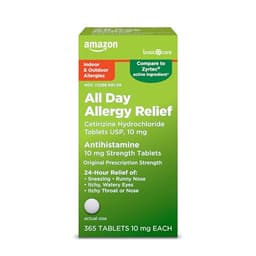
Amazon Basic Care Cetirizine (generic Zyrtec)
Best For
Same bioequivalence-proven relief as Zyrtec, at a fraction of the price
Works In
About 1 hour
Price
$13.57
$0.04 / count
Pros
- ✓FDA-required bioequivalence to Zyrtec — same active ingredient, dose, and mechanism
- ✓Independent pharmacokinetic studies confirm comparable absorption to the brand
- ✓Typically 80-90% cheaper per pill than Zyrtec
Cons
- ✗Inactive ingredients (fillers, dyes) can differ from Zyrtec's formulation
- ✗Pill shape and packaging vary by manufacturing lot
- ✗Same sedation profile as Zyrtec — going generic doesn't change the drowsiness tradeoff
We earn 1-4%/sale if you sign up · See all commissions
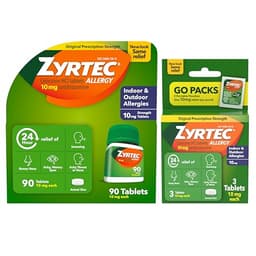
Zyrtec (cetirizine)
Best For
If you specifically want the brand-name box or a particular formulation the generic doesn't offer
Works In
About 1 hour
Price
$43.89
$0.47 / count
Pros
- ✓Identical clinical evidence base as the generic — same active ingredient
- ✓Wider range of specialty formulations (dissolvable tablets, liquid gels, children's versions)
- ✓Consistent, recognizable packaging and pill appearance
Cons
- ✗No efficacy advantage over bioequivalent generic cetirizine
- ✗Significantly higher per-pill cost for the same active ingredient
- ✗Not a better choice on the merits unless a specific formulation or excipient matters to you
We earn 1-4%/sale if you sign up · See all commissions
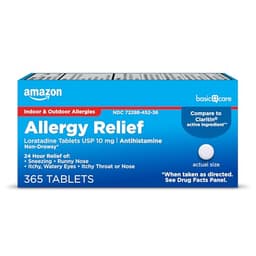
Amazon Basic Care Loratadine (generic Claritin)
Best For
Lowest-sedation option at generic pricing
Works In
1-3 hours
Price
$10.94
$0.03 / count
Pros
- ✓Same FDA bioequivalence requirement as generic cetirizine applies here
- ✓Loratadine already has a lower-sedation profile than cetirizine — generic doesn't change that
- ✓Typically 80-90% cheaper per pill than Claritin
Cons
- ✗Weaker symptom relief than cetirizine in head-to-head trials — a loratadine tradeoff, not a generic one
- ✗Inactive ingredients can differ slightly from Claritin's formulation
- ✗Slower onset than cetirizine
We earn 1-4%/sale if you sign up · See all commissions
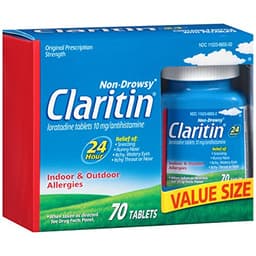
Claritin (loratadine)
Best For
If a specific Claritin formulation (RediTabs, liquid gels, children's syrup) fits your situation better
Works In
1-3 hours
Price
$19.91
$0.28 / count
Pros
- ✓Same active ingredient and evidence base as the generic
- ✓Broader formulation lineup, including dissolvable and pediatric options
- ✓Long track record and consistent branding
Cons
- ✗No clinical advantage over bioequivalent generic loratadine
- ✗Meaningfully higher per-pill price for identical active ingredient
- ✗Best reserved for cases where a specific formulation, not the drug itself, is the reason to buy brand
We earn 1-4%/sale if you sign up · See all commissions
Amazon prices retrieved from the Amazon Product Advertising API on . Prices and availability are accurate as of that time and may change.
The Cheapest Allergy Medicine That Actually Works
"Cheapest" and "actually works" aren't usually the same search — most rock-bottom options trade away efficacy. Generic allergy antihistamines are the exception, because the FDA's bioequivalence requirement means the cheap option and the expensive option are required to perform the same way in your bloodstream. There's no asterisk on the evidence for choosing generic.
If price is the deciding factor, store-brand cetirizine (generic Zyrtec) offers the strongest overall symptom-relief evidence of the major OTC antihistamines at the lowest per-pill cost of any of them — our full allergy medicine rankings cover the head-to-head efficacy data behind that ranking in more depth, including the sedation tradeoff cetirizine carries relative to fexofenadine and loratadine. For a closer look at how the three brand options stack up against each other specifically, see our Zyrtec vs. Claritin vs. Allegra comparison.
When the Brand Name Actually Matters
Honesty is the point of this article, so it's worth being direct about the situations where reaching for the brand-name box is a reasonable, non-wasteful choice — not because the drug itself works better, but because of something the generic doesn't offer.
Specific formulations the generic doesn't match. Not every generic line carries every formulation the brand does. Zyrtec and Claritin both sell dissolvable tablets, liquid gels, and children's chewables or syrups; some store-brand lines only stock the standard tablet. If a dissolvable format is what gets your kid to actually take the medicine — versus refusing a hard tablet — that's a legitimate reason to buy brand, or to shop specifically for a generic manufacturer that carries the same formulation, rather than defaulting to whichever tablet is cheapest.
A documented sensitivity to a specific inactive ingredient. Since generics aren't required to match the brand's exact inactive-ingredient list, a person who has previously reacted to a dye, filler, or coating in one version may tolerate a different manufacturer's version fine — brand or generic. A review cataloging inactive ingredients in oral medications found that pills routinely contain multiple excipients beyond the active drug, some of which are documented triggers for allergic or GI-type reactions in sensitive individuals PMID: 30867323. If you've had an unexplained reaction to a specific pill before, checking the inactive-ingredient list — brand or store-brand — matters more than the name on the box.
Peace of mind isn't nothing, but it isn't evidence either. Some people simply trust the brand they've always bought. That's a real preference, and there's no harm in paying for it if the price difference doesn't bother you — just don't confuse it with a clinical reason.
Outside of these situations, the price-per-pill table above is the whole story: identical active ingredient, identical evidence, and a meaningfully lower cost for the generic.
Our Recommendation
For most people without a known excipient sensitivity or a specific formulation need, store-brand generic cetirizine, loratadine, or fexofenadine is the rational default — you're getting FDA-required bioequivalence to Zyrtec, Claritin, or Allegra at a fraction of the price, with no efficacy tradeoff attached to the word "generic." Save the brand-name purchase for the cases above: a specific dissolvable or liquid formulation your household needs, or a documented reaction to a particular product's inactive ingredients. For the bigger picture on choosing between cetirizine, loratadine, and fexofenadine themselves — separate from the brand-vs-generic question — our seasonal allergies survival guide covers the full decision tree, including when an antihistamine alone isn't enough.
Frequently Asked Questions
Is Amazon Basic Care Cetirizine the same as Zyrtec? Yes. Both contain 10mg of cetirizine hydrochloride, the identical active ingredient, at the identical dose. The FDA required Amazon Basic Care's manufacturer to demonstrate bioequivalence to Zyrtec before approval, and independent pharmacokinetic studies of generic cetirizine tablets confirm comparable absorption to the branded product.
What's the actual difference between generic and brand allergy medicine? The active ingredient, dose, and mechanism are required to be the same. The differences are limited to inactive ingredients — fillers, binders, dyes, and coatings — plus packaging, pill shape, and price. That's not a purely cosmetic distinction for everyone, since some inactive ingredients can trigger reactions in sensitive individuals.
What's the cheapest allergy medicine that actually works? Store-brand cetirizine and loratadine — Amazon Basic Care, Equate, Kirkland Signature, or a pharmacy's own label — are the cheapest allergy medicines with full clinical evidence behind them, because they're bioequivalent to Zyrtec and Claritin at a fraction of the price. There's no meaningful efficacy tradeoff.
When does the brand name actually matter for allergy medicine? Mainly for specific formulations, not the tablet itself: dissolvable or liquid children's versions where texture and flavor affect whether a kid will take it, and documented sensitivity to a specific dye or filler used in one manufacturer's version but not another's.
Does the FDA really require generics to work the same as brand-name drugs? Yes. Generic approval requires the 90% confidence interval for AUC and Cmax to fall within 80-125% of the brand-name reference product. A broader meta-analysis across cardiovascular drug classes found no evidence that brand-name drugs outperformed generics in clinical outcomes.
Is generic loratadine (Claritin) or fexofenadine (Allegra) also bioequivalent to the brand? Yes — the FDA applies the identical 80-125% bioequivalence standard to every generic drug approval, not just cetirizine. Store-brand loratadine and fexofenadine go through the same pharmacokinetic testing against Claritin and Allegra before they can legally claim to be generic equivalents.
References
- Hauck WW, Parekh A, Lesko LJ, Chen ML, Williams RL. Limits of 80%-125% for AUC and 70%-143% for Cmax. What is the impact on bioequivalence studies? International Journal of Clinical Pharmacology and Therapeutics. 2001;39(8):350-355. PMID: 11515710.
- Onuh G, Adu JK, Bekoe SO, Johnson R, Adosraku RK, Asare-Nkansah S. Bioequivalence studies of cetirizine tablets using the urine excretion data of healthy Ghanaian male volunteers. Heliyon. 2023;9(1):e12665. PMID: 36691524.
- Kesselheim AS, Misono AS, Lee JL, et al. Clinical equivalence of generic and brand-name drugs used in cardiovascular disease: a systematic review and meta-analysis. JAMA. 2008;300(21):2514-2526. PMID: 19050195.
- Reker D, Blum SM, Steiger C, Anger KE, Sommer JM, Fanikos J, Traverso G. "Inactive" ingredients in oral medications. Science Translational Medicine. 2019;11(483):eaau6753. PMID: 30867323.