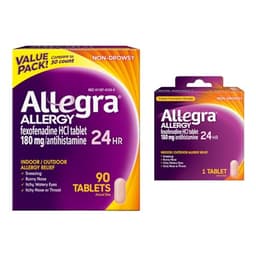
What Allegra is
Allegra is the brand name for fexofenadine, a second-generation antihistamine. It blocks histamine at H1 receptors, which calms sneezing, itching and a runny nose. The item we link to is Allegra Adult 24-Hour, fexofenadine 180 mg tablets, 90 count.
The label covers adults and children 12 and up: one 180 mg tablet once a day with water, and no more than one in 24 hours. Children under 12 need a pediatric product instead.
Fexofenadine is thought to enter the brain less than most other antihistamines, which would explain its low drowsiness.
How well it works
A 2026 network meta-analysis for the ARIA guideline panel found that the major second-generation antihistamines improve allergic rhinitis symptoms. Most differences between them were small, and safety profiles were similar PMID: 41707943.
The most useful direct evidence for Allegra is a head-to-head trial. In a two-week randomized, double-blind study of 495 people with moderate-to-severe seasonal allergies, fexofenadine 180 mg relieved symptoms as well as cetirizine 10 mg, the drug in Zyrtec PMID: 14582814. That matters because cetirizine is one of the stronger OTC options.
Expect relief within 1 to 3 hours. One dose covers 24 hours.
What it treats well: sneezing, runny nose, and itchy nose, eyes and throat.
What it doesn't treat well: a blocked, stuffy nose. Steroid nasal sprays such as Flonase relieve congestion better than antihistamine pills PMID: 9848901.
Drowsiness and other side effects
Low drowsiness is Allegra's main advantage. In the head-to-head trial above, people on fexofenadine reported significantly less drowsiness than people on cetirizine PMID: 14582814. In four prescription-monitoring studies covering more than 43,000 patients, fexofenadine's sedation rate was similar to loratadine's, while cetirizine's was higher PMID: 10784544. The authors suggested fexofenadine and loratadine as better fits for people in safety-critical jobs.
Practical tips:
- Take it with water, not fruit juice. The label warns against taking it with fruit juices, which can cut absorption.
- Don't take it at the same time as antacids that contain aluminum or magnesium.
- Ask a clinician first if you have kidney disease; you may need a different dose.
- Ask a clinician or pharmacist if you are pregnant or breastfeeding, or take other medicines regularly.
- Skip "Allegra-D" unless a clinician says it's fine. The "D" adds pseudoephedrine, which slightly raised systolic blood pressure and heart rate in a meta-analysis of trials PMID: 16087815.
Allegra vs. Zyrtec
This is the comparison most people are making. In the direct trial, relief was equivalent and drowsiness was lower with fexofenadine PMID: 14582814. Both brands cost about the same, roughly $15–20 a month by our estimate.
So the choice comes down to tolerance and price. If you drive for work, study, or felt foggy on Zyrtec, choose Allegra. If cetirizine doesn't make you drowsy, generic cetirizine gives similar relief for less. Allegra also has a routine to keep: water only, and away from certain antacids. Cetirizine has no juice rule.
Who should buy it
Buy Allegra if you need strong daily relief and must stay alert, or if Zyrtec made you drowsy.
Choose generic cetirizine if drowsiness isn't a problem and you want the lower price. Choose Claritin or generic loratadine if your symptoms are mild. Add Flonase or Nasacort if congestion is your main complaint.
See how it compares with the other options in our Best Allergy Medicines roundup.